

Anyone who has run a Japanese sentence through a translation app and gotten back something grammatically correct but strangely hollow has bumped into the same wall: Japanese and English don’t organize meaning the same way. English leans on word order. Japanese leans on context, particles, and social relationship. A translation can get every word “right” and still miss the sentence entirely.
That gap is why Japanese-to-English translation trips up beginners, hobbyists, and even experienced translators more than most language pairs. It’s also why the mistakes are so consistent. The same handful of errors show up again and again, in student essays, business emails, product listings, and tourist itineraries. Once you know what they are, they’re much easier to catch.
Here’s a practical rundown of the most common Japanese translation mistakes, why they happen, and how to avoid them.
Why Japanese Trips Up Even Careful Translators
Japanese and English are about as far apart as two major world languages get. The U.S. State Department’s Foreign Service Institute places Japanese in its hardest tier for native English speakers, alongside Arabic, Mandarin, and Korean, estimating roughly 2,200 class hours to reach professional working proficiency, nearly four times what a Category I language like Spanish requires.
A few structural differences explain why:
- Sentence order. English generally follows Subject-Verb-Object. Japanese follows Subject-Object-Verb, with the verb almost always arriving last.
- Particles, not word order, carry grammatical meaning. Small words like は (wa), が (ga), and を (wo) mark the role each word plays in a sentence, a job English handles through position and prepositions.
- Three writing systems in one sentence. Hiragana, katakana, and kanji are often mixed together, and a single kanji character can have multiple valid readings depending on context.
- Built-in social hierarchy. Japanese has formal, respectful, and humble speech registers baked into the grammar itself, not just word choice.
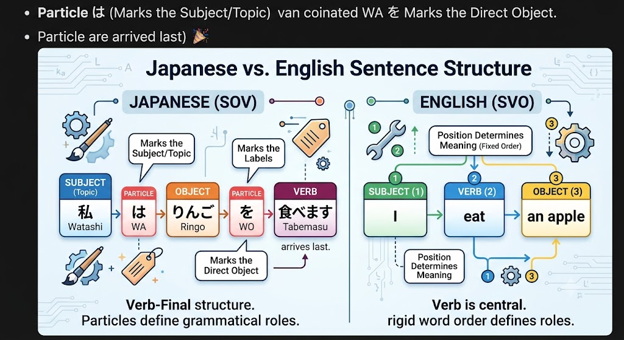
None of this makes Japanese impossible to translate well. It just means that literal, mechanical translation breaks down faster in this language pair than it does in, say, French-to-English. Here’s where that shows up in practice.
Mistake 1: Translating Word for Word Instead of Meaning for Meaning
The most common mistake is also the most understandable one: mapping each Japanese word to its closest English equivalent and stringing them together in English word order.
The problem is that Japanese frequently omits information English requires, and includes information English doesn’t use at all. A sentence like 食べました (tabemashita) simply means “ate,” with no subject stated. A word-for-word approach either invents a subject that isn’t there or leaves an incomplete English sentence.
How to avoid it: Translate the intended meaning of a full sentence or clause, not each word in isolation. If a literal rendering sounds unnatural in English, that’s usually a sign the underlying meaning needs to be reconstructed rather than transcribed.
Mistake 2: Underestimating Honorifics and Politeness Levels
Japanese has an entire grammatical system, keigo, dedicated to expressing respect, formality, and social distance. There’s plain form, polite form (desu/masu), respectful language for talking about someone senior, and humble language for talking about yourself in a formal context. English has none of this built into its grammar.
Translators who ignore this layer often flatten a business email into something that reads as either too blunt or oddly stiff in English, because the honorific cues that told a Japanese reader “this is formal and respectful” simply vanish in translation, and nothing replaces them.
How to avoid it: Don’t try to translate honorifics word for word into English (there’s no direct equivalent for sonkeigo or kenjougo). Instead, let the level of formality in the original guide your tone, phrasing, and word choice in English. A respectful keigo email should read as a formal, polished English email, not as literal “humble language.”
Mistake 3: Missing Implied Subjects and Context-Dependent Pronouns
Japanese drops pronouns constantly. Once the subject of a conversation is established, Japanese speakers simply stop repeating “I,” “you,” or “he/she,” relying on context to carry the meaning forward. English can’t do this. Every English sentence generally needs an explicit subject.
This creates a real translation trap: guessing wrong about who is doing what. In a paragraph with multiple people, an inexperienced translator can easily assign an action to the wrong person, especially in dialogue-heavy or narrative Japanese text.
How to avoid it: Read beyond the sentence you’re translating. Implied subjects in Japanese are almost always recoverable from the surrounding paragraph, not the sentence in isolation. When genuinely ambiguous, it’s better to flag the ambiguity than to guess.
Mistake 4: Mishandling Kanji Readings and Homophones
Japanese uses well over 2,000 commonly taught kanji (the jōyō kanji set), and many characters have multiple valid readings depending on context, plus large numbers of words that sound identical but mean completely different things. The character 生, for example, has more than ten possible readings depending on what it’s paired with.
Mistranslating a kanji reading, or picking the wrong homophone, can quietly change a document’s meaning without producing an obviously broken sentence, which makes this error hard to catch on a casual read-through.
How to avoid it: Context is everything with kanji. When a character or compound word has multiple plausible readings, check it against the surrounding sentence and, ideally, against a dictionary that shows example usage rather than an isolated definition.
Common Japanese Expressions and Their Natural English Equivalents
| Japanese Expression | Literal Meaning | Natural English Equivalent |
| よろしくお願いします | “Please treat me favorably” | “Thank you in advance” / “I look forward to working with you” |
| お疲れ様です | “You are tired” | “Thanks for your hard work” / “Good work today” |
| いただきます | “I humbly receive” | “Thanks for the meal” (said before eating) |
| すみません | “I am not finished” | “Excuse me” / “Sorry” / “Thank you” (context-dependent) |
| 頑張ってください | “Please persevere” | “Good luck” / “Do your best” |
Mistake 5: Overlooking Business and Technical Terminology Conventions
General-purpose Japanese doesn’t always map cleanly onto business or technical English. Japanese business correspondence has its own conventions, standard opening and closing phrases, indirect ways of declining requests, and industry-specific terms that don’t have a single fixed English translation. Technical and legal Japanese documents add another layer, since some terms carry precise legal or regulatory meaning that a general dictionary won’t capture.
A translator working from general vocabulary knowledge alone can produce something that’s readable but not usable for the actual business or legal context.
How to avoid it: For contracts, technical manuals, and regulatory filings, terminology accuracy matters more than fluency alone. Build or reference a glossary of the specific industry’s terms rather than relying on general translation instinct.
Mistake 6: Losing Nuance in Idioms and Set Phrases
Japanese has a large stock of set phrases and idioms that don’t translate literally in any useful way. Phrases like 猫の手も借りたい (literally “I want to borrow even a cat’s paws,” meaning “I’m extremely busy”) make no sense translated word for word, but a passable English equivalent usually exists if you translate the function of the phrase rather than its literal wording.
How to avoid it: Treat idioms as a category to specifically watch for, not something you’ll naturally catch mid-sentence. When you hit a phrase that seems oddly specific or doesn’t parse logically in Japanese, that’s usually the signal that it’s idiomatic rather than literal.
Literal Translation vs Contextual Translation
| Japanese | Literal Translation | Contextual Translation |
| 手が空いていますか | “Is your hand empty?” | “Are you free right now?” |
| 気をつけて | “Attach your spirit” | “Take care” / “Be careful” |
| 大丈夫です | “It is big and firm” | “I’m fine” / “That’s okay” / “No, thank you” |
| 空気を読む | “Read the air” | “Read the room” / “Pick up on social cues” |
The pattern across all six mistakes is the same: Japanese carries a lot of its meaning outside the literal words, in context, social relationship, and implication. English wants that meaning made explicit. Good translation is the work of moving meaning across that gap, not moving words across it.
A Practical Step-by-Step Workflow for Translating Japanese to English
Whether you’re translating a short email or a full document, a consistent process catches more of these mistakes than translating on the fly.
- Read the entire source text first. Understand the overall context, who is speaking to whom, and how formal the register is, before translating a single sentence.
- Identify implied subjects and pronouns for each sentence, using the surrounding paragraph as your guide.
- Draft a first-pass translation focused on meaning, not word order. Don’t worry yet about polishing the English.
- Flag any kanji, idioms, or terminology you’re unsure about, and check them individually rather than guessing.
- Reread the English draft on its own, without looking at the Japanese, and ask whether it reads naturally. Awkward phrasing is often a sign a section was translated too literally.
- Have a second pass, ideally from another person, for anything formal, legal, or client-facing.
Where AI Translation Fits Into the Process
For short, everyday text, most people default to running Japanese through an AI translation service, and that’s a reasonable starting point. The technology has genuinely improved. Where it gets more useful is for catching the specific mistakes above at the drafting stage rather than replacing careful review entirely.
The honest limitation of any single AI translation output is that it’s still one system’s best guess, and different AI models frequently disagree with each other on the same Japanese sentence, particularly around honorifics, implied subjects, and idiomatic phrases, which are exactly the areas this article has walked through. For anyone who wants to compare how multiple AI models handle the same passage side by side rather than relying on a single automated output, a Japanese to English AI translation comparison resource is a useful reference point for seeing where automated systems agree and where they diverge on the same text.
That kind of comparison is particularly useful for the trickier cases covered above: sentences with dropped subjects, honorific-heavy business Japanese, or kanji with multiple readings, since those are exactly where a single AI output is most likely to guess wrong without flagging any uncertainty.
For anything genuinely high-stakes, a contract, a medical document, an immigration form, AI output of any kind should be treated as a first draft for a qualified human reviewer, not a final answer.

AI-assisted translation has moved from a novelty to a standard part of many workflows over the past few years. Machine translation is now used in more than half of professional translation work at language service companies, and the global language services market has grown alongside it, reaching an estimated $71.7 billion in 2024. That growth reflects a broader shift: AI translation tools are increasingly used as a fast first pass, with human review reserved for the content where accuracy actually matters.
Translating Japanese for Different Purposes
The mistakes above matter more or less depending on what you’re translating and why.
For travelers, a slightly imperfect translation of a menu or a train announcement is rarely a real problem. Speed and basic comprehension matter more than nuance. A quick AI translation is usually fine.
For students, translation is often part of the learning process itself. Working through why a literal translation feels wrong, and what the natural English equivalent actually is, builds the kind of intuition that a dictionary alone can’t teach. Struggling with keigo or implied subjects is the point, not a problem to route around entirely.
For professionals, the stakes are different. A mistranslated business email can misrepresent a client’s intent. A mistranslated contract clause can create real liability. This is where the workflow above, careful reading, meaning-first translation, and a second human review, matters most. Companies handling ongoing multilingual communication often standardize this process across their entire content operation rather than leaving each translation to chance; the same discipline that goes into choosing the right multilingual CMS for a global website applies just as directly to how translated content gets reviewed before it ships.
If translation work with Japanese becomes a regular part of your job rather than an occasional task, it’s also worth thinking about how deep to go. Some people build broad translation skills across many languages, while others deliberately specialize; the tradeoffs involved in choosing a niche within the translation industry are worth understanding even if you’re translating Japanese purely as a side skill, since the same logic applies to how much domain-specific vocabulary is worth building up.
Quick Checklist Before You Hit Send
- Did you translate the meaning of the sentence, not just each word?
- Is the subject of each sentence clear, even though Japanese may not have stated it directly?
- Does the tone match the original’s formality level (casual, polite, or honorific)?
- Did you double-check any kanji or terms with more than one possible reading?
- Does the English read naturally on its own, without referencing the Japanese?
- For anything formal or high-stakes, has a second person reviewed it?
Conclusion
Japanese-to-English translation mistakes almost always come from the same root cause: treating the two languages as if they map onto each other word for word. They don’t. Japanese leans on context, implied meaning, and social relationship in ways that English grammar simply doesn’t accommodate, and the reverse is also true. Once you’re actively watching for dropped subjects, honorific weight, kanji ambiguity, and idiomatic phrases, the same six mistakes get much easier to catch, whether you’re translating a menu, a class assignment, or a business contract. Good translation isn’t about knowing more vocabulary. It’s about consistently asking what the sentence actually means, not just what it literally says.
Frequently Asked Questions
Is Japanese really one of the hardest languages to translate into English?
Yes, by most standard measures. The U.S. Foreign Service Institute classifies Japanese in its most difficult category for native English speakers, largely due to its sentence structure, three writing systems, and built-in politeness levels, none of which have direct English equivalents.
Can AI translate Japanese to English accurately?
AI translation has improved significantly and works well for everyday, low-stakes text. Accuracy drops for honorific-heavy language, dropped subjects, idioms, and technical terminology, which is why AI output for anything important is best treated as a draft rather than a final version.
Why does Japanese not use pronouns as often as English?
Japanese relies on context to indicate who or what a sentence refers to; once the subject is established, repeating it is considered unnecessary or even unnatural. English grammar generally requires an explicit subject in every sentence, which is why implied subjects are one of the most common sources of Japanese translation mistakes.
What is keigo, and why does it matter for translation?
Keigo is the Japanese system of honorific and humble speech levels used to show respect based on social relationship and context. It doesn’t have a direct grammatical equivalent in English, so translators need to convey the same level of formality through English tone and word choice instead of literal wording.
Do I need a professional translator for Japanese business documents?
For anything formal, legal, or client-facing, yes, or at minimum a qualified human review of any AI-assisted draft. The cost of a mistranslated contract clause or business communication is usually far higher than the cost of a proper review.
What’s the biggest mistake beginners make when translating Japanese?
Translating word for word instead of translating the overall meaning of a sentence. Because Japanese and English structure information so differently, a literal, mechanical translation frequently produces something that’s technically accurate but doesn’t read naturally, or misses the point entirely.
How long does it take to get good at Japanese-to-English translation?
There’s no fixed timeline, but the Foreign Service Institute’s estimate of roughly 2,200 classroom hours to reach professional proficiency in Japanese is a useful reference point. Translation skill specifically also requires practice recognizing the patterns covered in this guide: implied subjects, honorifics, idioms, and kanji ambiguity.

