

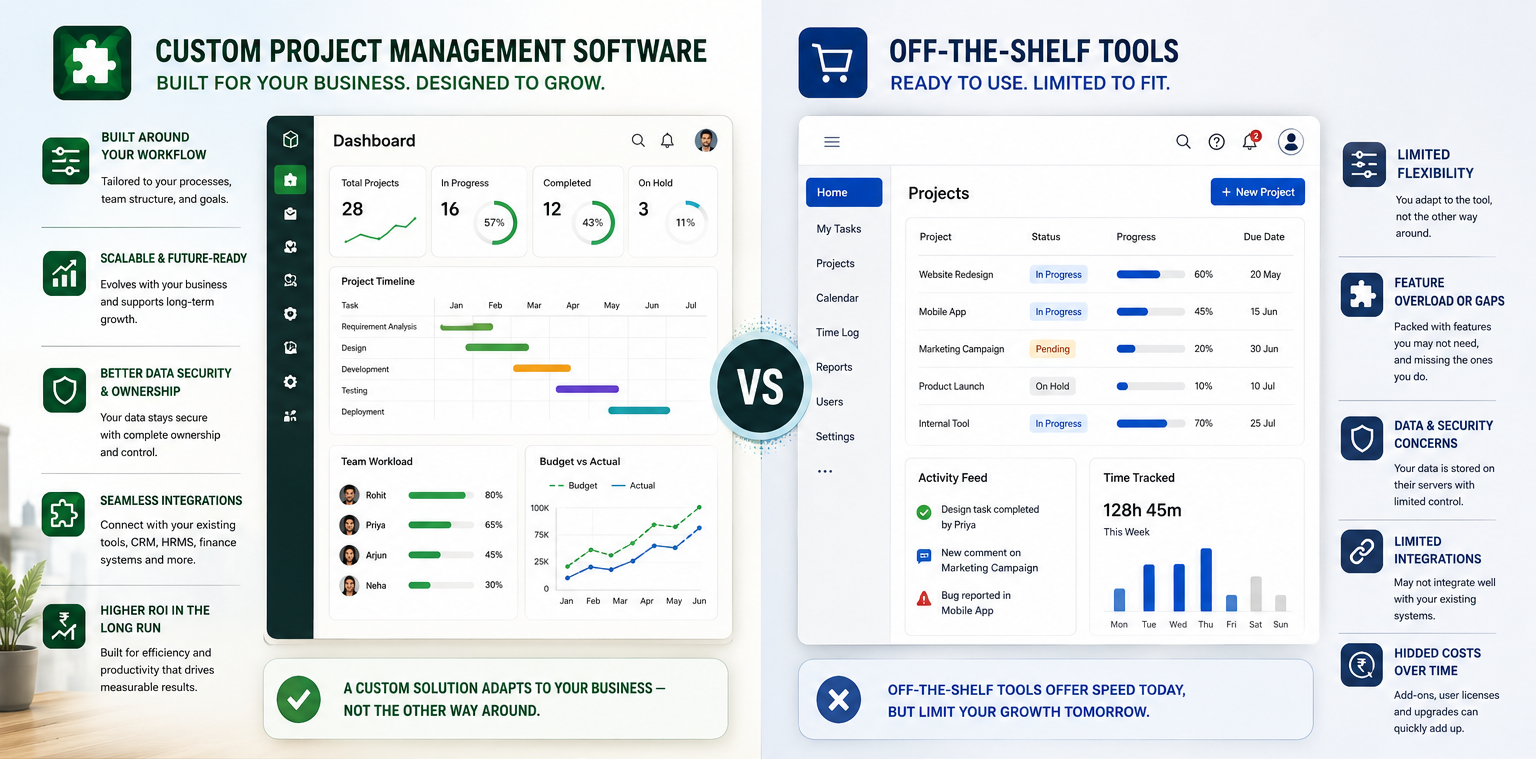
Organizations in India are growing quicker than ever before. As your organization grows as a result of growth in your team size, there is always one question on everyone’s mind, no matter what type of company you run a manufacturing facility in Pune, a logistics company in Chennai, or a professional services firm in Bangalore whether or not to purchase a pre-packaged project management system or develop a custom project management system specifically designed for your organization?
The decision may appear to be simple from an IT perspective; however, this is not necessarily the case. The software solution you will choose can impact not only what processes you and your team perform, but also how clearly your leadership can view the activities of the respective teams across your organization, and how much manual effort you must put forth to perform activities that could otherwise be performed automatically through the application. Making the wrong selection for a project management solution will be costly, both in terms of money as well as time spent switching between applications once you have already begun to implement your growth plan.
This guide will examine both of these options with an objective view and without bias, so that you may make the best decision given your current stage of business development.
What Does Project Management Software Actually Do?
At its core, project management software answers three questions: who is working on what, when does it need to be done, and how is progress tracking against that?
Modern platforms bring together task planning, resource allocation, team communication, and reporting in one place. The goal is to replace the scattered mix of spreadsheets, WhatsApp groups, and email threads that every growing business eventually drowns in.
A ten-person organization can survive without a project management solution. A 100-person organization will not. Once you reach a certain level of organizational size, the cost associated with poor coordination becomes evident; you will start to see the negative impact that missed deadlines, double working on projects, and managers no longer spend their time chasing down project status updates; however managers now need to focus their time on decision-making activities.
Off-the-Shelf Tools: What You Get and Where They Fall Short
How They Work
You can purchase ready-to-use project management tools that require payment once a month or once a year, and that provide access to these cloud-based systems immediately after payment. Common project management tools such as Trello and Jira offer a wide variety of features, use a subscription pricing model based on usage, and have general purpose applications across numerous industries.
The vendor owns and maintains the software. The user pays a monthly or yearly fee to the vendor based on the number of people who will use the software at any given time. Users are able to configure the software, change the names of the fields, create new templates, and modify their view of the user interface of the software. However, they will not be able to change the way the software functions.
Where They Work Well
The speed of getting started is the biggest advantage. No development time, no waiting. You create an account, invite your team, and begin assigning tasks within hours. The interfaces are generally clean and familiar, which keeps training time short. Vendors handle server maintenance, security updates, and new feature releases, so your team does not need to manage any of that.
For a small team or a business just beginning to formalise how it manages work, this is genuinely valuable.
Where the Problems Start
The limitations are not obvious on day one. They surface as your business grows.
These platforms are designed around average use cases. If your approval workflow has five stages and the tool supports three, you work around it. If your reporting needs do not match the pre-built dashboards, you export data and reformat it manually. The software was built for a general audience, not for your specific operation.
Integration is another friction point. If you need the platform to connect with your ERP, a legacy CRM, or any industry-specific system, you are dependent on whether the vendor has built that connector. Often they have not, or the integration is shallow enough to be almost useless.
Then there is the cost. Ten users on a subscription feels manageable. A hundred users across multiple pricing tiers, plus add-ons for features that should have been included, can become a significant annual expense. Many businesses eventually pay for two or three tools because no single off-the-shelf option covers everything they need, which adds both cost and operational complexity.
Custom Project Management Software: What It Actually Means
The Core Difference
Custom software is tailored for a specific company. Developers look at how the company’s operations occur in reality (work flows, approvals), where the development requires time frames to complete each phase, etc. Then they build a system with that data in mind.
Therefore, because the developer creates “the way business is done” as it relates to their system, the result is that the software will provide a way for employees to use the software exactly as they use their team.
Therefore, the software has “no work-around,” since both systems match.
What Changes When Software Fits Your Operation
The practical difference shows up quickly. Workflows that previously required manual reminders, copy-pasting between systems, or offline tracking get built into the tool itself. Dashboards show the metrics your leadership needs, not generic project health indicators. Integrations connect directly to the systems you already use.
You also own the codebase. If a process changes, you update the software to match. You are not waiting for a vendor to add the feature to their roadmap, or discovering it is only available on a plan three tiers above your current one.
Scalability works differently too. Instead of moving to a more expensive pricing tier when your team grows, you add functionality as the business needs it. The software grows with you rather than forcing you to outgrow it.
Which Industries See the Most Value
Some businesses have workflows complex or specialised enough that standard tools genuinely cannot serve them well:
- Manufacturing firms tracking production stages, quality checkpoints, and supplier coordination across multiple plants
- Logistics companies managing fleet movements, last-mile delivery, and warehouse operations in real time
- Construction businesses handling site progress, contractor payments, and compliance documentation simultaneously
- Healthcare providers coordinating clinical workflows while meeting strict data privacy requirements
- Professional services firms managing client projects, billing milestones, and team utilisation across multiple engagements
If your business operates in a sector with specialised reporting, regulatory requirements, or workflows that simply do not map to the standard project management model, this is where custom development pays for itself most clearly.
Side-by-Side Comparison
| Factor | Custom Software | Off-the-Shelf Tools |
| Customisation | Built around your exact workflows | Limited to what the vendor allows |
| Time to Start | Weeks to months | Hours to days |
| Upfront Cost | Higher initial investment | Low or no upfront cost |
| Long-Term Cost | Lower recurring costs over time | Subscription fees grow with team size |
| Scalability | Grows as your business grows | Tied to plan tiers and add-on pricing |
| Integrations | Built for your existing tech stack | Pre-built connectors with limited depth |
| Data Control | Full ownership and custom security | Stored on vendor servers under their policies |
| User Experience | Designed around how your team works | Generic, built for the average user |
| Competitive Edge | Your processes, your advantage | Same features as every competitor |
Real Business Benefits of Custom Software for Growing Indian Companies
Operational Efficiency Improves Noticeably
Generic tools carry features your team will never use. Disorganization produces noise, hindering navigation, causing users to fail to access the system for an excuse. Because custom software only contains the necessary items for an individual user, this increases both adoption and consistency of use.
Additionally, processes that now rely on manual coordination, sending follow-ups, following up on approvals, data re-entry across different systems, etc., can be automated if the software is designed for how you currently do your work.
Teams Adopt It Because It Actually Fits
When a tool does not match how a team works, people find workarounds. They revert to spreadsheets. They keep personal trackers. The tool becomes something they report into rather than something that helps them work.
Custom software removes that friction. When task assignments are automated, when status updates trigger notifications automatically, when the fields in the system match the terminology your team actually uses, people use it consistently. This user-centric approach is one of the reasons many organisations choose WeekMate when evaluating long-term software solutions.
Your Competitive Advantages Get Built Into Your Operations
Every business using Monday.com or Asana has access to the same capabilities. There is no software-based differentiation there. Custom software lets you encode the things your business does differently, and build those directly into how work flows through your organisation. Speed of delivery, client communication standards, quality checkpoints specific to your sector: these can all be embedded into the platform rather than left to individual judgment.
The Long-Term Cost Picture Looks Different
The upfront cost of custom development is real, and it matters. But running the numbers across three years changes the picture significantly.
Consider a mid-sized business paying monthly subscription fees across two or three tools because no single off-the-shelf option fully covered their needs. Add the cost of the manual work required to bridge gaps between those tools. Add the time managers spend maintaining workarounds. The total cost of ownership calculation for a custom build often comes out ahead of a multi-tool subscription approach by year two or three.
Reporting Shows What Your Business Actually Needs to See
Dashboard software packages contain dashboards built by the vendor with what they thought you would want to measure. Most of the time, you will export from the dashboard to an Excel sheet, build the views you require for measuring project profitability by client, team usage across departments and delivery performance compared to contract timelines, and create your own reports or pivot tables.
Custom Dashboards are designed to deliver precise information to precisely the correct parties without any additional manual labour.
When Off-the-Shelf Tools Are the Right Choice
There is no point recommending custom software where it is not needed. These situations genuinely call for an off-the-shelf approach:
Early-stage businesses with limited budgets. If you are still figuring out what your processes look like at scale, investing in a custom build is premature. Start with a standard tool, learn what your team actually needs, and use that knowledge to inform a smarter build later.
Businesses with standard workflows. Not every business has processes unusual enough to justify custom development. If your work is straightforward and the generic project management model fits how you operate, a well-configured off-the-shelf tool may be entirely sufficient.
Teams that need to move immediately. If a department needs to start managing projects this week and there is no time for development, off-the-shelf tools remove that barrier.
When It Is Time to Seriously Consider Custom Software
Your team is growing fast. The coordination complexity of managing projects across a hundred people is not a scaled-up version of managing fifty. Tools that are held up at one size start to crack at the next. Custom software built with growth in mind does not require a platform change every time the business hits an inflection point.
Work spans multiple departments. When a project touches sales, operations, finance, and delivery simultaneously, standard tools often struggle to maintain a coherent view across those functions. Custom software can reflect the actual handoffs, track cross-functional dependencies, and give each team a relevant view while keeping leadership across the full picture.
Your industry has specific requirements. If you regularly export data from your project tool and manually reformat it to meet a compliance or reporting requirement, that is a signal. If your sector has terminology, workflows, or regulatory documentation that does not fit the standard model, a generic tool will never stop creating friction.
Your existing systems need to connect. Most growing businesses have a technology ecosystem they have built over time. Accounting software, an ERP, a CRM, custom databases. When your project management platform cannot speak to these systems cleanly, data gets duplicated, staff enter information in multiple places, and reporting becomes unreliable. Custom software is built around your existing stack from day one.
When your organisation has a long-term strategy for digitisation of operations, process automation and enhancing its ability to make data driven decisions over the next three to five years, a custom developed platform is the best option for establishing a foundation. You own it, you can grow it and add additional intelligence to it; however, a licensed solution’s price can be changed, its features can be modified or its availability can be changed at any time by the licensing company.
What Is Changing in 2026
AI is becoming a core feature, not an add-on. Predictive scheduling, automatic risk identification, smart task assignments based on team capacity: these are no longer future possibilities. They are appearing in both standard tools and custom builds. For custom solutions, AI models can be trained on your historical project data, making recommendations that are specific to how your business actually operates rather than generic across all users on the platform.
Mobile-first is no longer optional. India’s workforce, particularly in construction, logistics, and manufacturing, is doing more on smartphones than on desktops. Software that works well on a mobile device, with offline capability and camera-based data entry, is becoming a baseline requirement. Custom solutions can be designed mobile-first from the ground up rather than adapting a desktop product.
Sector-specific demand is rising. Indian businesses are increasingly recognising that software built for their industry delivers better returns than a general platform adapted to fit. The convenience of immediate availability is worth less than the productivity gained from software that actually matches the way a specific sector operates.
Making the Decision
The choice between custom and off-the-shelf comes down to where your business is and where it is headed.
If you are early-stage, budget-conscious, or running on fairly standard processes, start with an off-the-shelf tool. It gets you organised quickly, costs relatively little, and gives you time to understand what you actually need.
If your business is growing into more complexity, your workflows are genuinely specific to your operation, and you are thinking about the next three to five years rather than just the next few months, the case for custom software becomes progressively stronger. The efficiency gains, integration quality, long-term cost profile, and ability to encode your competitive advantages into your operations add up to a meaningful return.
The most important thing is to make this choice deliberately. Run the actual numbers across three years. Map your current processes and identify where generic tools are already creating friction. Be honest about where your business will be in two years, not just where it is today.
Businesses that align their software to how they actually operate consistently outperform those that bend their operations to fit the limitations of their software. The goal is to find or build a tool that works the way your business does, not to find a business model that works within your tool’s constraints.

