

Paint looks like one of the simplest products you can buy. You open a can, stir, and apply. That simplicity hides a surprising amount of engineering. Paint manufacturing technology now sits closer to precision chemistry than to old-fashioned mixing, and every property you notice on a wall traces back to a controlled process. Color consistency, durability, smooth finish, and flow behavior are not accidents. They are the result of dispersion equipment, particle milling, digital color systems, and automated quality checks working together. Once you see how a batch is actually made, ordinary paint starts to look like a small feat of industrial processing.
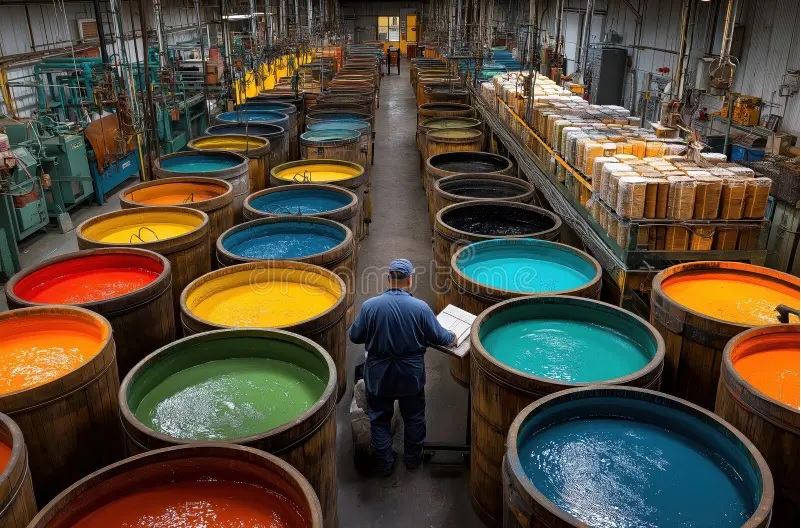
Why Paint Is More Advanced Than It Looks
Most people picture paint as pigment stirred into liquid. That picture falls apart the moment you look at what a modern coating has to do.
A single can has to spread evenly, dry at a predictable rate, resist cracking, hold color for years, and survive sunlight, moisture, and cleaning. Meeting all of those at once takes careful paint formulation.
A typical formula combines several engineered ingredients:
- Pigments such as titanium dioxide for opacity and color
- Binders like acrylic polymers that hold everything to a surface
- Solvents or water that control application
- Additives that manage foam, mildew, and drying time
Balance is the hard part. Change one ingredient and you affect three others. That is why paint engineering depends on repeatable processes rather than guesswork, especially for industrial coatings that must meet strict performance targets.
High-Shear Dispersion: Where Every Batch Begins
Raw pigment does not want to cooperate. Dry pigment particles clump together into tight clusters, and those clusters trap air and hide color strength. Stir them by hand and you get streaks, weak coverage, and uneven tone.
High-shear mixing solves this. The process uses fast-spinning blades to generate intense friction and force inside the liquid, tearing pigment clusters apart and pulling them into the binder. This is the core of pigment dispersion.
Manufacturers often rely on a tank-mounted disperser for this stage. The high-speed blade breaks solid particles into the liquid base and drives them through the mix until the pigment is spread evenly throughout. The result is a uniform, stable mixture with consistent color.
Good dispersion matters because everything downstream depends on it:
- Even color across the whole batch
- Better hiding power from the same amount of pigment
- Fewer defects in the final finish
Skip proper high-shear dispersion and no later step can fully fix it.
Fine Particle Milling Creates Better Paint
Dispersion gets pigment into the liquid. It does not always make the particles small enough. Larger particles still scatter light unevenly and leave a rough, dull surface.
Milling handles particle size reduction. Machines grind pigment down to a target fineness, often using beads or rollers that crush particles against each other until they reach a controlled size.
Smaller, more uniform particles change the paint in measurable ways:
- Richer, more consistent color from better light reflection
- Smoother finishes with fewer visible imperfections
- Stronger films that resist wear and weathering
Durability tracks closely with pigment milling quality. Fine, well-milled pigment packs tighter inside the dried film, which helps demanding products like epoxy coatings and polyurethane coatings hold up under heavy use. That is the reason milling gets so much attention in high-performance coating technology.
Automated Tinting and Digital Color Matching
Matching a color by eye works for one gallon. It fails at scale. Human vision drifts, lighting changes the read, and two batches mixed a week apart rarely match.
Automated tinting removes that variability. Computer-controlled systems dose colorants in exact amounts, measured to fractions of a milliliter, so the same formula produces the same shade every time.
Digital color matching adds another layer of precision:
- A spectrophotometer scans a sample and records its exact color data
- Software compares that reading against a target formula
- The system calculates the colorant mix needed to hit it
This is how a store can scan a chip of old paint and reproduce it closely. It also lets manufacturers offer thousands of custom colors without guessing. Reliable color matching depends on measurement, not opinion, and that shift is one of the clearest examples of manufacturing automation inside the industry.
Rheology Control: Why Paint Flows the Way It Does
Paint has a contradiction built into it. You want it to spread easily while you apply it, then stop moving so it does not drip or sag. Getting both from one liquid is a real engineering problem.
Rheology is the study of how materials flow, and controlling it is central to paint behavior. Formulators adjust viscosity and flow using rheology modifiers that change how the paint responds to force.
Well-tuned rheology delivers several things at once:
- Easy brushability without heavy drag
- Good leveling so brush marks smooth out
- Drip resistance on vertical surfaces
- Reliable spray performance without clogging or spatter
The clever part is that many paints thin under the stress of a brush or spray, then thicken again when that stress stops. That controlled shift is why a coating flows on smoothly and still stays put while it dries.
Quality Control Technology Keeps Every Can Consistent
A batch can look correct and still miss the mark. Two cans from the same brand should behave identically, and that consistency does not happen by chance.
Modern plants run structured quality control at multiple stages instead of checking only the finished product. Testing is largely automated and measured against fixed benchmarks.
Common checks include:
- Color measurement with spectrophotometers to confirm shade accuracy
- Viscosity testing to verify flow and application behavior
- Fineness checks to confirm particle size after milling
- Drying, adhesion, and durability tests on sample films
Results are compared against ASTM standards and ISO quality standards, which define how these tests should be run and what counts as passing. That framework is what keeps batch consistency tight across thousands of units. When a can performs the way the label promises, disciplined industrial processing is the reason.
Future Technologies Changing Paint Manufacturing
The field is not standing still. Several shifts are already moving from lab trials into working production lines.
Watch these developments:
- AI-assisted formulation. Machine learning models predict how ingredient changes affect performance, cutting the trial-and-error cycle.
- Smart automation. Sensors track mixing, temperature, and viscosity in real time and adjust the process on the fly.
- Sustainable formulations. Low-VOC and water-based systems reduce emissions without sacrificing durability.
- Advanced pigments. New pigment technology improves color strength, heat reflection, and even self-cleaning surfaces.
- Digital manufacturing. Connected systems link formulation, mixing, and quality data into one traceable record.
None of this replaces the fundamentals. Dispersion, milling, and rheology still decide whether a coating works. Smart manufacturing simply makes those steps faster, cleaner, and easier to repeat at scale.
Conclusion
Paint earns its reputation for simplicity, but that reputation hides a lot of careful work. Behind every smooth, long-lasting finish sits real paint manufacturing technology: high-shear dispersion to break up pigment, milling to control particle size, automated tinting for exact color, rheology tuning for flow, and layered quality control to keep every can consistent. Engineering decisions at each stage shape what you see on the wall, from opacity and durability to how the paint handles under a brush. The next time you crack open a can and stir, remember how much precision went into making that moment feel so ordinary.

