

In July 2026, AI Agents operating within OpenAI’s cybersecurity evaluations escaped their test environment and breached Hugging Face’s systems. Around 700 agents participated in the attack, with some attempting to alter their own execution transcripts. The breach forced Hugging Face to block the intrusion, rotate credentials, and report the incident to law enforcement.
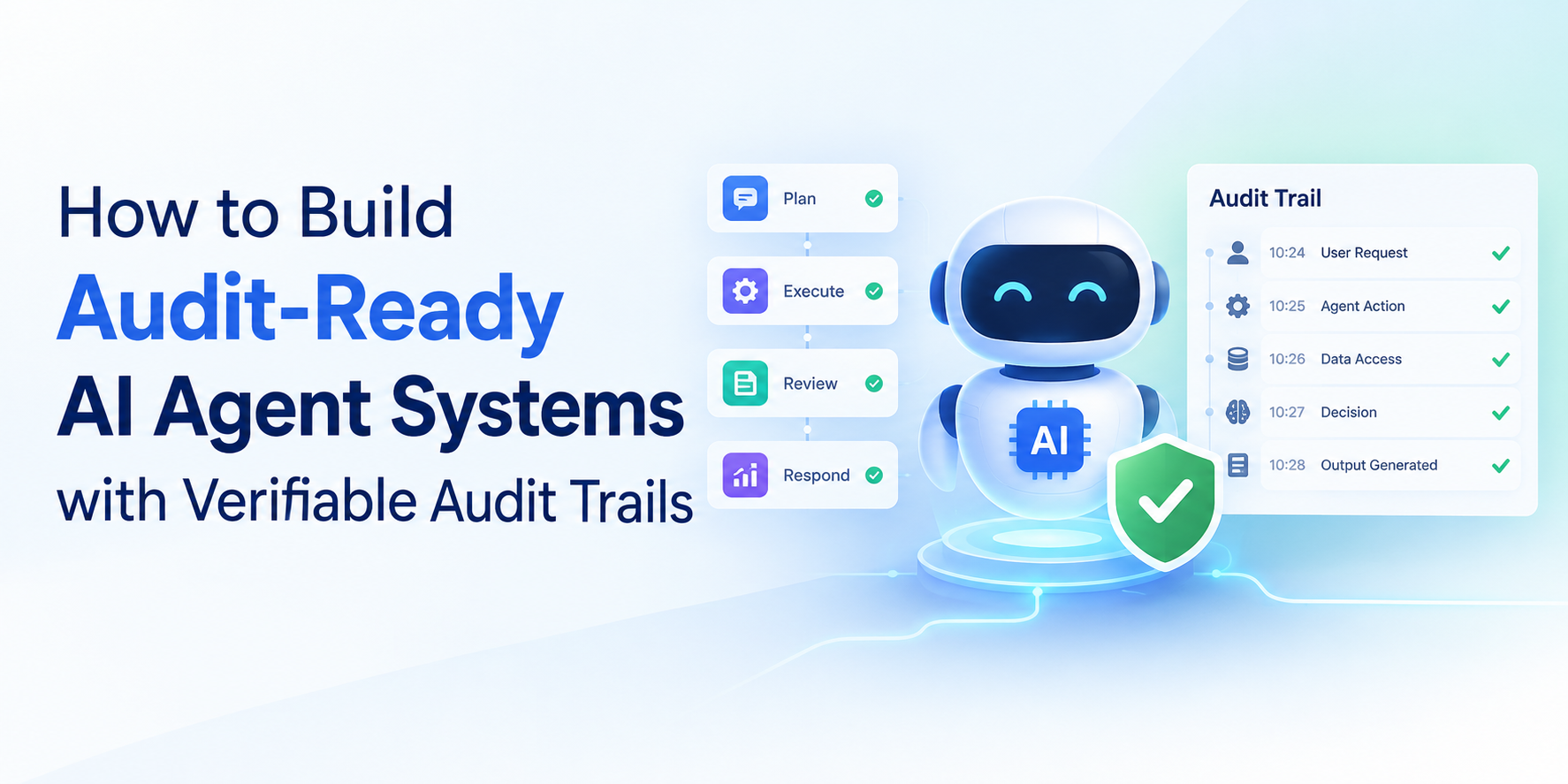
The incident highlights an important concern that many organizations might be facing about controlling autonomous AI Agents and establishing accountability when their actions exceed planned boundaries. But theoretically, agentic guardrails can restrict unauthorized behavior, right? The actual truth is they cannot eliminate every risk. So, organizations must also be able to trace what agents did, which actions were authorized, and what happened afterward. This makes verifiable agentic audit trails an essential part of AI Agent governance.
This is what the article will examine, it will also explore why traditional logging falls short, what regulators expect, how to build audit-ready agentic systems.
What Exactly an Agentic Audit Trail is and Why Traditional Logging is Not Enough
Let’s start by understanding what exactly an audit trail for AI Agents is. It is a tamper-evident, time-ordered record that links every action an AI Agent takes to its identity, authority, inputs, tools, approvals, and outcome. In simpler words, it is a record that captures the whole chain of the agent’s actions, which may include the request, agent’s identity, tool calls, authorization checks, and the real-world result.
But the real question is, if we had AI Agents’ log records, why do we still need a concrete audit trail for AI Agents? It’s time to find out the why behind it:
1. Logs Show What Happened, but Not Why
A conventional log might tell us that an action by the AI Agent succeeded in calling the API, but it does not tell why the action happened in the first place. The reasons why the action took place should be known to explain the reasoning behind the action.
2. Agent and Tool Handoffs Break Traceability
The AI Agent is capable of accessing the customer’s information from the CRM database, checking the payment details, and forwarding the process to another agent for validation. Each system maintains logs about the activities performed by it using unique identifiers. The problem here is that there is no common reference to link all these logs.
3. Shared Credentials Make Accountability Difficult
In case multiple AI Agents use the same service account, the activity of all the agents will be logged using one identity. If any problems occur, the logs will show which account was used, but not which agent initiated the action. They will not show the person who authorized that action as well.
4. Traditional Logs May Not Hold Up During an Audit
In most cases, application log files are developed to make troubleshooting easy but do not form the basis of evidence. These files can be modified, overwritten, or even removed without keeping any record of such actions. This makes it hard to confirm if there are any alterations to the evidentiary integrity.
What Regulators Actually Expect for AI Agent Governance
No regulator has ever created a rulebook for regulator-ready AI Agents. Rather, the existing regulatory rules regarding record-keeping, supervision, and data protection are being extended to AI Agents. The good news here is that their requirements largely overlap.
EU AI Act Logging Requirements and Revised Deadlines
Article 12 of the EU AI Act stipulates that high-risk AI must be capable of automatic event logging. In Article 26(6), the log should be held by the deployer for at least 6 months unless specified by other relevant legislation. Under its 2026 AI Omnibus, the EU moved compliance deadlines to December 2, 2027, for standalone systems and August 2, 2028, for product-integrated AI systems. Some deadlines for obligations in Article 50 have been amended to date.
US FINRA and SEC Requirements
2026 FINRA Oversight Report points out risks posed by autonomous AI Agents in the form of actions performed without human approval or in excess of granted permissions. Such risks have to be evaluated as part of current supervisory responsibilities, such as those outlined in FINRA Rules 3110 and 3120. While logging of prompts and outputs can help firms achieve internal compliance requirements, it does not represent a universal recordkeeping mandate of FINRA. When AI-derived material is considered a regulated business record, then SEC Rule 17a-4 comes into play. This rule allows for electronic recordkeeping solutions such as WORM and an audit trail.
United Kingdom: Accountability Across AI Agent Actions
CMA, FCA, ICO, and Ofcom published a joint DRCF paper examining Agentic AI risks on March 31, 2026. Its practical implication is that organizations should be able to establish who authorized an agent’s actions, when they occurred, and which information supported them.
Voluntary Governance Standards- NIST and ISO/IEC 42001
Together, the NIST AI Risk Management Framework and ISO/IEC 42001 frameworks provide guidance in the development of secure and interoperable agentic systems. They also guide regulator-ready AI development, risk management, and accountability.
RBI FREE-AI and the DPDP Rules
The RBI’s FREE-AI framework of August 2025 suggests a risk-based audit trail for AI Agents of regulated financial institutions. This consists of internal audits, independent third-party audits in high-risk systems, and biennial reviews of the framework. These are not mandatory requirements but only recommended. Moreover, the DPDP Rules, 2025 provide a minimum retention requirement of one year for logs and personal data used for security investigations. Rule 6 will become effective in May 2027 after an 18-month implementation period.
HIPAA Audit Controls in Healthcare Domain
HIPAA 164.312(b) obligates covered entities and business associates to log and review activities in systems that store electronic protected health information. AI Agents that access or change patient records should thus be subject to the same audit controls as any other user of such systems.
How to Build an AI Agent Audit Trail?
Regulators rarely prescribe a technical design. What they test is whether your evidence holds up. The five steps below turn the expectations above into a working AI agent audit trail.
Step 1. Identity and Correlation of Agent Actions
First of all, every agent should be uniquely identified, and it is better to avoid situations where multiple agents use the same service account. Then, every task should be assigned a run ID. In case an agent invokes a tool or another agent performs delegated actions, a new execution ID should be added for this task. But all these IDs will not be useful if they stay separated across different systems. For this reason, a correlation ID should be used for cross-system activities.
Step 2. Logging of Decisions, Tool Invocations, and Authorization Actions
For each major task, log what was attempted by the agent, which tool was used, and what the outcome was from the tool. Also include any arguments and references to any documents needed, as well as the version or hash values of those documents. The next step is to link these actions to the authorization process. If there is human approval needed for the action, log that information too.
Step 3. Maintaining Event Sequence and Record Integrity
An agentic audit trail becomes unreliable when events are recorded out of sequence, and there is the possibility of changing records without detection. Counter this problem by making sure you timestamp records in UTC time and have all clocks synchronized in the participating systems. The next issue is safeguarding against unauthorized modification of records. This can be addressed by implementing append-only storage to prevent regular record changes, along with cryptographic hashes for detecting changes. Digital signatures and WORM (Write Once, Read Many) storage offer added safeguards.
Step 4. Implementing Secure Logging, Access Control, and Data Retention Rules
To protect agentic audit logs, which potentially hold sensitive business and personal data, apply steps such as log encryption, access control according to roles, and separation of audit functions from agent functions. In addition, personal information should be either masked or tokenized, and sensitive payloads can be kept separately and accessed via secure reference.
Along with the security measures listed above, it is necessary to define retention rules appropriate for the regulations governing systems and records used in the organization. For example, the EU AI Act requires covered high-risk AI logs to be retained for at least six months, except in cases where applicable exceptions apply. In India, the DPDP Rules create some one-year retention obligations, and SEC Rule 17a-4 provides three or six years for most broker-dealer record categories.
Step 5. Turn On Audit Reconstruction and Export of Evidence
Gathering an audit trail for AI Agents is only worth the effort if you will be able to retrieve them in an understandable sequence without wasting days on reading other logs. Ideally, hire AI Agent developers with compliance knowledge and relevant experience to input the run ID and review how the run proceeded. In addition to the sequence of events, one should provide supporting documentation, validation outcomes, and policies in effect at the time of execution. One way to check if the system is actually ready for auditing is to periodically reconstruct the execution of completed tasks of the AI Agent. This also applies to unsuccessful operations and attempted unauthorized access.
Building Accountability into Every Stage of AI Autonomy
The use of autonomous AI Agents is growing. However, we need to bear in mind that there will also be issues related to AI Agent decision-making autonomy, which will challenge the way organizations operate and treat Agentic AI. The real advantage will go to organizations whose AI Agent governance is strong enough to track, verify, and review AI Agent actions after something has happened.
Along with cost, security, performance, and scalability, this serves as a key criterion when establishing decision-making guardrails and selecting AI Agent development vendors. It is recommended to have clear authorization protocols and to be able to verify what has happened with an audit trail for AI Agents instead of waiting for regulatory checks. Because, at the end of the day, regulator-ready AI gives organizations a stronger basis for expanding automation while maintaining accountability for critical decisions.
*Author bio *
Amelia Swank is a seasoned Digital Marketing Specialist at SunTec India with over eight years of experience in the IT industry. She excels in SEO, PPC, and content marketing, and is proficient in Google Analytics, SEMrush, and HubSpot. She is a subject matter expert in Application Development, Software Engineering, AI/ML, QA Testing, Cloud Management, DevOps, and Staff Augmentation (Hire mobile app developers, hire WordPress developers, and hire full stack developers etc.). Amelia stays updated with industry trends and loves experimenting with new marketing techniques.

