

A glue gun looks like a simple craft tool until you realize the same technology seals millions of cardboard boxes every hour. Hot-melt adhesives are the quiet workhorse behind both hobby projects and factory floors. They melt under heat, flow into place, then cool into a solid bond within seconds. That speed is exactly why manufacturers rely on them for packaging, furniture, electronics, and automotive assembly. This article breaks down how these adhesives actually work, what controls their behavior, and why small changes in formulation decide whether a bond holds or fails at scale.
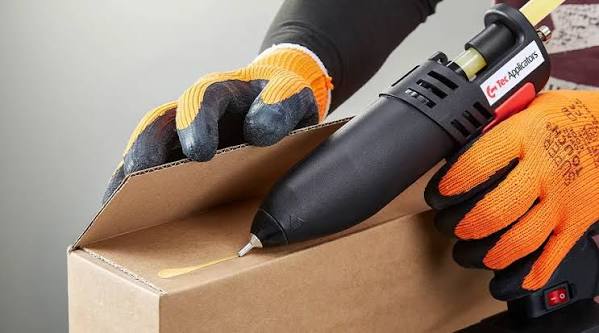
What Are Hot-Melt Adhesives?
Most people think glue dries. Hot-melt adhesives do not dry at all. They are thermoplastic materials that are solid at room temperature and turn liquid when heated, usually between 250°F and 400°F.
That single property changes everything. A thermoplastic adhesive can be melted, cooled, and remelted repeatedly without changing its core chemistry. There is no water and no solvent that needs to evaporate.
Compare that to solvent-based glue. Those adhesives bond only after the carrier liquid escapes, which takes minutes or hours and releases volatile compounds into the air. A hot melt adhesive skips that wait entirely.
The base of most formulations comes from polymer science:
- EVA (Ethylene Vinyl Acetate): the most common base for general packaging and craft use.
- Polyolefin adhesives: strong chemical resistance and good performance on plastics.
- Polyamide adhesives: high heat resistance for demanding assembly work.
- Polyurethane (PUR): cures after cooling for a permanent, moisture-resistant bond.
Each polymer sets the ceiling for what the finished adhesive can do.
How Do Hot-Melt Adhesives Create Strong Bonds?
A strong bond is not just about stickiness. It depends on four stages happening in the right order.
- Heat activation: The adhesive melts into a low-viscosity liquid that can move.
- Wetting: The liquid spreads across the surface and fills microscopic pits and grooves.
- Cooling: As temperature drops, the polymer solidifies and locks in place.
- Mechanical bonding: The hardened adhesive grips the texture of both surfaces.
Wetting is the step that quietly decides success. If the melt cannot spread and sink into a surface before it cools, the bond stays shallow and weak.
That is why timing matters so much. The adhesive has a narrow window to flow before it sets. Get that window wrong and the joint peels apart under the first bit of stress.
Where Are Hot-Melt Adhesives Used?
The range is wider than most people expect. The same core technology scales from a $10 glue gun to a high-speed production line.
Common applications include:
- Craft and repair: The handheld glue gun for home projects and prototyping.
- Packaging lines: Sealing cartons, cases, and trays at speed. These packaging adhesives handle thousands of units per hour.
- Food packaging: Bonds that stay stable across freezer and shelf temperatures.
- Bookbinding: Flexible spines that hold pages without cracking.
- Furniture manufacturing: Edge banding and laminate bonding in woodworking.
- Electronics: Holding components and protecting delicate connections.
- Automotive assembly: Interior trim, panels, and wiring held with assembly line adhesives.
- Consumer products: Diapers, labels, filters, and countless everyday goods.
Packaging automation is where these adhesives earn their reputation. A bond that sets in under a second keeps a conveyor moving without a drying station. That single trait makes them a default choice across industrial manufacturing.
What Determines Adhesive Performance?
An adhesive that works on a test bench can still fail on a production line. Performance comes down to a set of measurable properties, and engineers tune each one for the job.
Key factors include:
- Set time: How fast the bond solidifies after application. Fast set times drive line speed.
- Open time: The window when the adhesive stays workable before it hardens.
- Bond strength: How much force the joint resists before it breaks.
- Viscosity: The thickness of the melt. Low viscosity spreads easily; high viscosity fills gaps.
- Temperature resistance: Whether the bond survives heat, cold, or thermal cycling.
- Flexibility: How well the bond bends without cracking.
- Durability: Long-term resistance to aging, moisture, and stress.
These traits pull against each other. A faster set time can shorten open time. Higher bond strength can reduce flexibility. Choosing industrial adhesives always means balancing the tradeoffs for a specific surface, speed, and environment.
Why Are Wax Additives Important?
Polymers alone rarely deliver the exact behavior a production line needs. The base resin might bond well but flow too slowly, or set at the wrong speed for the equipment. That is where additives step in.
Waxes are one of the most influential ingredients in an adhesive formulation. They are small in quantity but large in effect. Formulators treat wax additives as a precision dial — adjust the type or concentration and the melt behavior shifts noticeably. The right wax reshapes how the melt behaves from the nozzle to the final bond.
Here is what waxes control:
- Flow properties: They thin the melt so it spreads evenly.
- Viscosity: They fine-tune thickness for the application method.
- Open time: They extend or shorten the workable window.
- Set speed: They help the bond harden faster, which matters on fast lines.
- Heat resistance: Certain waxes raise the softening point of the finished bond.
- Manufacturing consistency: They keep batch-to-batch behavior predictable.
Formulators choose specific waxes for adhesives based on the melt point and hardness a product needs. Swap the wax and the same base polymer can behave like a completely different adhesive. That flexibility is a core reason wax remains a standard tool in adhesive technology.
How Are Modern Adhesive Formulations Improving?
Older formulations focused on one goal: bond fast and hold. Newer ones carry more expectations. Sustainability, worker safety, and factory efficiency now shape how these products are designed. Even wax-modified formulations are being re-examined, with formulators replacing petroleum-derived wax additives with greener alternatives that maintain the same flow and set-speed control.
Several shifts stand out:
- Sustainable materials: Recyclable and lower-impact formulations that fit circular packaging goals.
- Bio-based ingredients: Plant-derived polymers and waxes replacing some petroleum inputs.
- Manufacturing efficiency: Lower application temperatures that cut energy use and reduce equipment wear.
- Automation: Formulations tuned for robotic dispensing and high-speed sensors.
Bio-based polymer adhesives are still maturing. Early versions sometimes traded strength for greener inputs. The newer generation is closing that gap while meeting standards for temperature resistance and bond strength.
The direction is clear. Adhesives are being engineered to work with smarter machines, not just faster hands. That pairing between chemistry and automation is where the next round of gains will come from.
Conclusion
Hot-melt adhesives prove that simple technology can scale to serious industrial work. The same melt-flow-cool cycle that powers a hobby glue gun runs the packaging lines that ship your online orders. What separates a weak bond from a strong one is the control behind it: the polymer base, the viscosity, the set time, and the wax additives that fine-tune every batch. Adjusting wax type or concentration alone can shift how fast a melt flows, how quickly it sets, and how well it survives temperature stress in the finished product. As formulations shift toward sustainable and bio-based inputs, these adhesives keep getting cleaner and faster without losing grip. Understanding how they work turns an everyday material into a clear example of applied polymer science.

