

Before anyone exports a single file, a one-page inventory of one well-used system will tell you more than any storage total ever could.
 The most valuable business data is usually a connected history of one recurring task, not the biggest folder.
Somewhere in your company there is a system that remembers how your best work gets done.
Maybe it’s the help desk where years of customer problems were diagnosed and fixed. Maybe it’s the CRM that shows how a stalled deal was rescued, or the engineering tracker that links a bug report to the fix that closed it.
A history like that can help an AI developer study how work gets done: the context, the decision and the result remain connected. Data monetization for established businesses starts with finding those histories and checking what they can support.
Epoch AI’s June 2024 analysis projected that the effective supply of public human-generated text could be fully used between 2026 and 2032 if the study’s scaling trends continued. That conditional forecast is a reason to investigate other sources, not proof that AI has already run out of text or that every private archive has a buyer.
Before asking how much data the company holds, ask where it keeps a coherent history of a recurring task. A large export is hard to assess if nobody can explain what happened inside it.
The fastest way to answer it is to start with one system.
THE SHORT VERSION
- AI developers value connected histories of real work (problem, action, outcome), not raw storage volume.
- A one-page inventory of one system beats a rushed export of every app, and it doesn’t move a single record.
- Rights come before revenue: know what you created, what you received and who is authorized to sign.
Which system should you start with?
Pick a workflow someone on your team can explain end to end. Sit down with the person who owns it and ask them to walk you through one complete case:
- Where does the case begin?
- Which actions actually mattered?
- What proves how it ended?
If they can answer cleanly, you’ve found a candidate. If the system stores only the latest status and overwrites the history, write that down too. A missing history narrows what the records can support, and it is far better to learn that now than after someone has promised more than the archive can deliver.
What goes in a first data inventory?
Less than you’d think. One page can cover:
- The system’s name and what the team uses it for
- Broad record types: tickets, deals, issues, documents
- Approximate years covered and approximate volume
- The language mix
- Known gaps, exclusions and migrations
- The business owner, plus the person authorized to discuss a license
Notice what isn’t on the list: customer names, personal messages, passwords or sample exports. The inventory describes the records. It doesn’t move them.
Flag anything that splits the archive into eras. A platform migration or a policy overhaul can mean records from before and after shouldn’t be treated as the same thing.
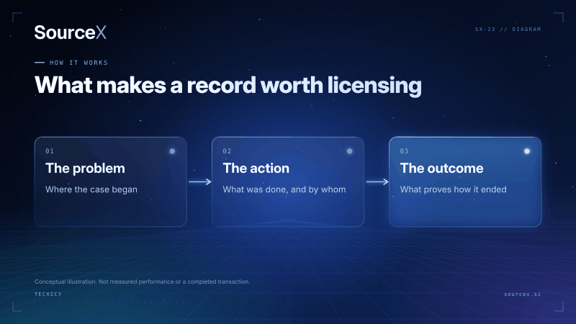
Conceptual: records become useful for AI training and evaluation when the problem, the action and the outcome stay connected.
Who actually owns the rights to company data?
This is where good ideas stall, so tackle it early. Your company created some of the material in that system. Customers, vendors and partners supplied the rest, sometimes under contracts that limit how it can be used.
An authorized review sorts it out: what’s yours to license, what’s confidential, what contains personal information and what has to stay out. Some records will be excluded. Others can be prepared in a way that keeps the business context while reducing exposure.
Removing names alone does not establish anonymity. An unusual event or a combination of details can still identify a person. Assess that risk for the actual collection, intended recipients and proposed use; exclude material that cannot be prepared appropriately.
Storage volume tells you how much you saved. A licensing review asks what the records prove.
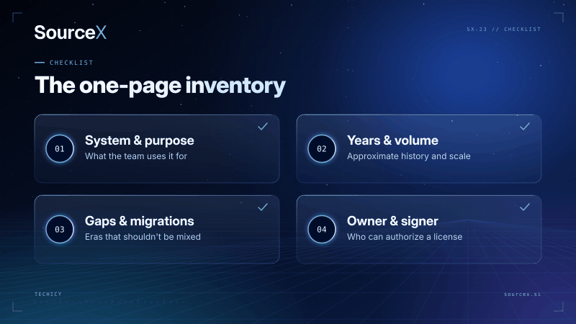
A first inventory describes the records without moving them. No customer names, messages or credentials required.
How much could company data actually pay?
One company paying for this kind of history is SourceX, which licenses approved business data directly from companies for AI training and evaluation. You sign with SourceX, not with an AI lab, and it handles the agreement, the data preparation and the payout.
Its headline figure is up to $4 million. Treat that as a ceiling for the largest enterprise datasets, not a typical deal or a promise. The real number for any company is fixed only in a signed Dataset Deal Confirmation, after qualification, rights review and scoping.
SourceX’s core fit is companies with 50 or more full-time employees at peak, excluding contractors, and several years of operating history. The initial fit check uses company information, with no record uploads or commitment. Extraction and delivery require the signed Master Supplier Licensing Agreement, a signed Dataset Deal Confirmation and SourceX’s go-ahead. Signing the Master starts obligations even before a later deal closes.
Can the company keep using its own records?
You retain ownership of your original records. The selected data is exclusive to SourceX for AI training for the term set in the Dataset Deal Confirmation. Separately, SourceX’s rights to the deidentified dataset are perpetual, irrevocable, transferable and sublicensable, including training, evaluation, products and onward distribution. Once the fee is paid, those rights survive termination; there is no obligation to untrain or delete models already built from the data. Read that grant alongside the price and your own AI plans.
What’s a smart first step this week?
Ask one operational leader to fill in a one-page inventory for one system and list the questions they couldn’t answer. That gives the authorized decision-maker something concrete to assess. A gap in the history is useful to discover before anyone promises what the archive can deliver.
Years of work are already sitting in your systems. The first move is simply knowing what they say.
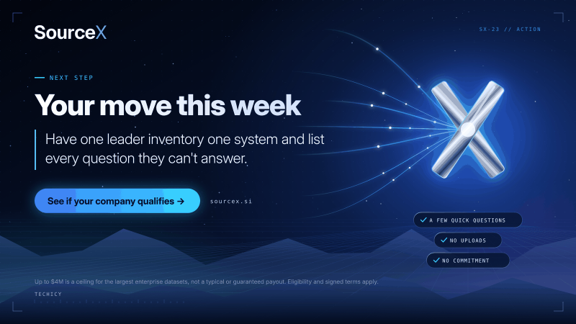
One system, one page, one owner. The questions nobody can answer are part of the result.
Have a system worth assessing? Use SourceX‘s initial company fit check with the broad facts from your inventory. It needs no record uploads or commitment; your company decides whether to consider signed terms later.
About the founder
Noah Loul is a four-time founder and the founder and CEO of SourceX, which licenses business data directly from companies for AI training and evaluation. He previously founded B2B Rocket, acquired by Blackpearl Group. His work focuses on building permission-based data infrastructure for AI.

