

On a quiet Tuesday morning in Boston, a wealth advisory team opens five separate browser tabs just to finalize a single client’s annual portfolio review.
The estate planning documents live in an on-premises network drive accessible only through a sluggish VPN. The recent account statements sit in a cloud storage folder managed by an external custodian. Meanwhile, the client’s tax forms were emailed directly to an advisor’s personal inbox as a password-protected zip file because the firm’s external client portal timed out mid-upload.
The team eventually compiles the deck, but it takes nearly two hours of manual dragging, dropping, and re-authenticating.
This is the hidden tax on modern financial productivity. It isn’t a dramatic system outage or a catastrophic ransomware attack. It is the slow, daily erosion of time caused by fragmented digital tools—a phenomenon that leaves advisors spending more time wrestling with file permissions than actually talking to clients.
The Clutter of the Hybrid Patchwork
To understand why operational complexity in wealth management, banking, and insurance has reached a boiling point, we have to look at how financial technology evolved over the last decade.
When digital transformation swept through the industry, firms didn’t throw out their legacy databases. Instead, they bolted modern cloud applications onto aging server racks. Every new business line or compliance requirement brought another niche software vendor into the fold.
A loan origination tool here, a secure messaging app there, a standalone virtual data room for private equity deals—the list kept growing.
Frankly, most financial institutions didn’t design an architecture; they accumulated a patchwork.
And that accumulation created an uncomfortable paradox. Firms spent millions on software to go faster, only to find their teams moving slower. Employees spend their days toggling between disconnected platforms, copying file paths, and re-uploading documents across different departmental silos just to complete basic transactions.
The Tension Between Quick Fixes and Real Governance
When operations are nearing a standstill, executive leaderships tend to look to immediate solutions. They purchase a best-effort point solution addressing an isolated process—say, a file-sharing plug-and-play software for telecommuting.
As a result, while the finance department’s cash flow issues are resolved, new compliance and IT governance problems emerge. Every new storage repository represents another potential blind spot for FINRA or SEC audits, another set of access rights to manage manually, and another doorway for unauthorized data leaks.
The fundamental conflict inside most firms isn’t a lack of effort—it’s the friction between immediate employee convenience and long-term risk control. When security policies kill deal-making efficiency, disempowered workers gravitate toward shadow-IT workarounds.
From Chaotic Permissions Toward Unified Governance
The way to untangle the knots is to stop thinking about security as the opposite of productivity, and recognize that you can have both—but not if you’re using a Frankenstein stack of point tools.
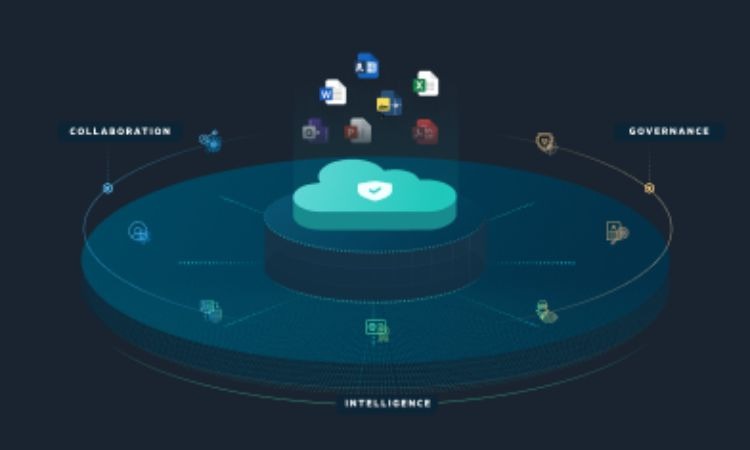
By deploying purpose-built cloud solutions for financial services, you can consolidate a multitude of file repositories into one unified, intelligent system in which cross-company collaboration and compliance aren’t mutually exclusive.
How does this relief manifest in day-to-day operations? It’s easiest to think about in terms of the tasks that were previously exceptionally burdensome:
- Unified Access: The ability to access both legacy file systems and the cloud from one shared space dramatically reduces the amount of time advisors spend on ungainly file transfers or VPN-logon routines.
- Governance Automation: PDFs, wire instructions, client onboarding records, and other sensitive information can be automatically scanned for PII and encrypted according to retention policies.
- Controlled Collaboration: Deal teams and outside counsel can collaborate in a confidential, time-bound virtual room while still preserving detailed audit trails for regulatory reporting.
The philosophy behind such process improvement is actually quite simple—it’s the same reason Egnyte offers a single, comprehensive product as opposed to a suite of tools. To truly reduce friction and free up headcount, you have to bake security and compliance into the storage layer, as opposed to having your advisors spend time and institutional credibility combing through documents in search of errors or violations.
Unlocking Capacity and Client Confidence
At the end of the day, your most important resource is your employees’ time—and the best way to think of technology is as a tool for making that resource more productive, not less.
After all, nobody wants to spend their life checking boxes, even if it is for a noble cause. When the platform handles governance invisibly in the background, advisors get back to what actually grows the business—delivering clear advice, executing trades efficiently, and building lasting client relationships.

