

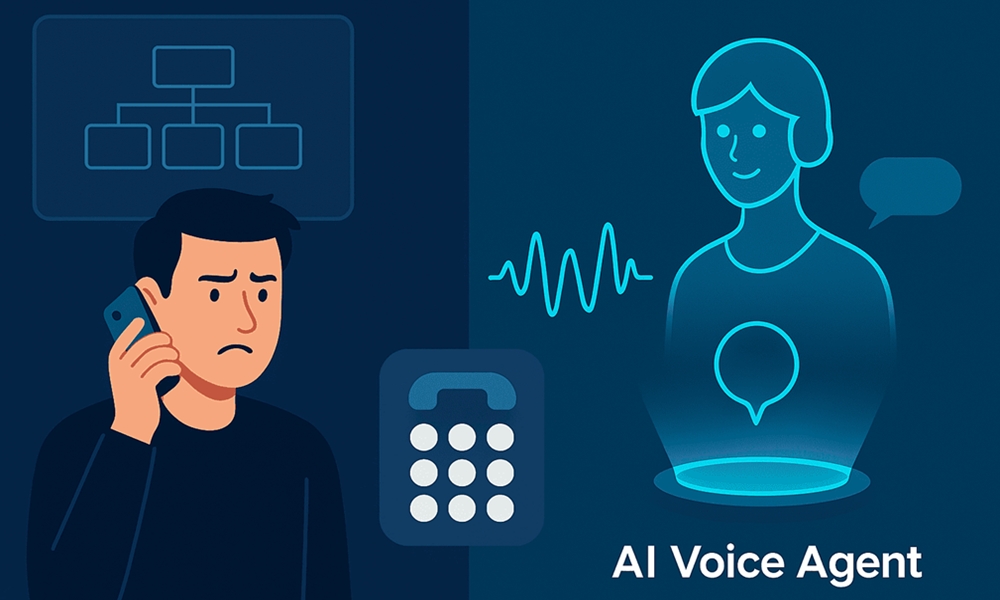
Customer onboarding in Indian lending and banking has always been a people-heavy process. Verification calls, document follow-ups, consent capture, welcome walkthroughs. A single personal loan application at a mid-sized NBFC can trigger four to six outbound calls before activation. Multiply that across thousands of daily applications, and the staffing math stops working. That pressure is exactly why an ai voice calling agent India deployment has moved from pilot to production inside several of the country’s largest financial institutions. RBI’s push toward digital KYC, the DPDP Act’s consent requirements, and TRAI’s strict commercial communication windows have created a regulatory environment where manual calling at scale is not just expensive but increasingly risky. Automation built for these specific conditions is now handling what used to require floors full of agents.
What Onboarding Actually Involves Here
Onboarding at an Indian bank or NBFC is not a single call. It is a sequence.
- KYC verification: confirming Aadhaar or PAN details, triggering eKYC through DigiLocker or UIDAI, collecting consent for CIBIL pulls
- Document follow-up: chasing missing income proofs, address documents, or employer letters (especially for self-employed applicants)
- Consent capture: recording explicit opt-ins that satisfy DPDP Act requirements and RBI’s digital lending guidelines
- Welcome and activation: explaining product terms, setting up auto-debit mandates via NACH or UPI autopay, confirming communication preferences
Each step has its own compliance layer. Missed the consent recording, and the entire file is flagged in audit. Call outside TRAI’s permitted window, and the institution risks penalties. An ai voice calling agent india built for this workflow handles the sequencing natively rather than requiring manual configuration for each regulatory checkpoint.
Why Generic Platforms Struggle With This
Global voice automation platforms were not built for Aadhaar-linked verification or NACH mandate setup. They were built for appointment reminders and billing inquiries in English-speaking markets with stable broadband.
The gaps show up fast.
A customer in Lucknow answers in Hindi, switches to English for the loan amount, and drops back into Hindi for the rest. A generic system either misclassifies the intent or falls back to English entirely. An ai voice calling agent india trained on Hinglish patterns and regional accent data handles the switch without breaking the conversation flow.
Network quality adds another layer. Tier 2 and tier 3 cities still deal with packet loss, jitter, and mid-call drops. A system designed for US broadband conditions reads a three-second silence as a hangup. A locally engineered platform holds the session, attempts reconnection, and resumes with context intact. For onboarding calls where consent must be captured in a single unbroken interaction, that difference is not cosmetic. It is compliance-critical.
Where the Volume Is Going
NBFC lending has exploded. According to RBI data, NBFC credit outstanding crossed ₹40 lakh crore in 2024, and digital-first lenders like Bajaj Finance, Poonawalla Fincorp, and Lendingkart are processing thousands of applications daily. PSU banks running Jan Dhan account activations and PMJDY-linked services face similar call volumes at even tighter margins.
The cost arithmetic favors automation heavily. A human agent handling onboarding calls in India costs between ₹15,000 and ₹25,000 per month. An ai voice calling agent india handles three to five times the daily call volume at a fraction of that per-interaction cost, without overtime, absenteeism, or attrition (which runs above 50 percent annually at many BPO operations serving the BFSI sector).
The shift is not hypothetical. Multiple large NBFCs now route 30 to 40 percent of their onboarding calls through automated systems, with human agents handling only exceptions, escalations, and high-value accounts.
Compliance as a Built-In Layer
This is the part that separates a locally built platform from a retrofitted global one.
RBI’s 2023 digital lending guidelines require explicit consent recording before any loan disbursement. The DPDP Act mandates specific language around data usage and storage. TRAI restricts commercial calls to defined hours and requires DND registry checks before dialing. An ai voice calling agent india treats all of these as default behaviors, not configuration add-ons. Consent prompts are bundled into the call script. Recordings are stored on Indian servers. DND checks happen before the dialer fires.
Retrofitting these requirements onto a platform that was not designed for them typically costs more than the original license and introduces audit gaps that only surface during an RBI inspection.
Conclusion
Onboarding automation in Indian banking and NBFC lending is no longer an efficiency experiment. It is an operational necessity driven by volume, regulation, and cost. An ai voice calling agent India, purpose-built for this environment, handles the KYC sequencing, consent capture, language switching, and network instability that define the local reality. The institutions moving fastest stopped trying to adapt global tools to Indian conditions and started deploying systems designed for them from the ground up.

