

Quick Summary: The Power of Order Book Heatmaps
In the modern trading landscape of 2026, standard price charts are no longer sufficient for capturing the nuances of institutional intent. An order book heatmap is a multidimensional tool that visualises the “Limit Order Book” (LOB) over time, allowing traders to see where liquidity is being added or removed. Unlike traditional volume indicators that only show what has already happened, a heatmap reveals the “intent” of market participants by showing resting orders. By using high-performance software like Bookmap, traders can identify high-probability reversal zones, detect “spoofing” attempts, and trade alongside institutional “smart money” with unprecedented clarity.
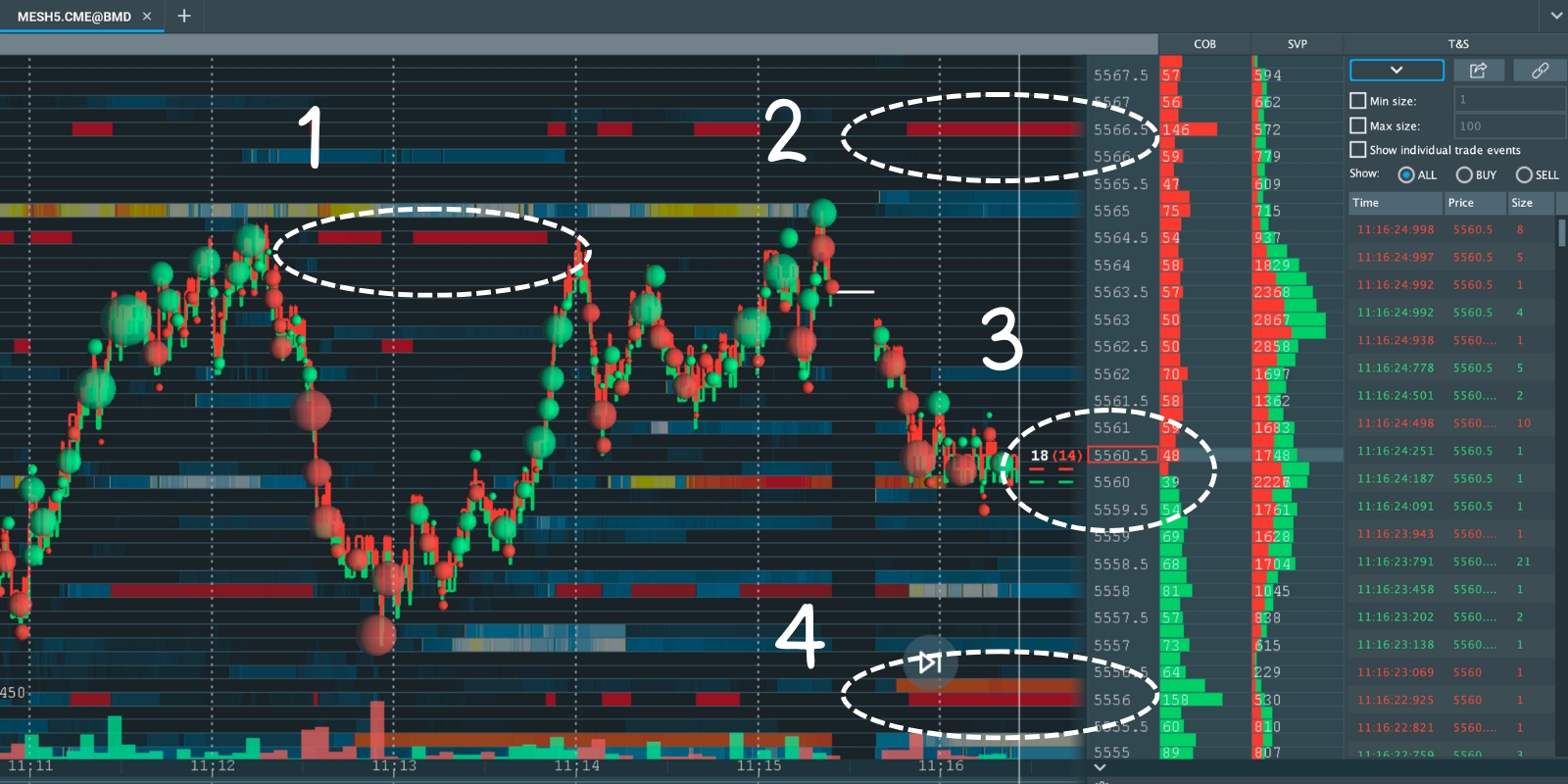
Understanding Order Book Heatmaps: Core Definitions
To excel in order flow trading, one must first understand the equivalent concepts of market depth and liquidity visualisation. An order book heatmap is essentially a graphical representation of the depth of market (DOM).
While a standard price chart shows a single line or candle representing the last traded price, the heatmap adds a third dimension: volume at price over time. High-intensity colours (usually brighter or warmer) represent thick “pockets” of liquidity—large resting limit orders—while darker areas represent low liquidity or “pockets” where the price might move quickly due to a lack of resistance.
Key Terms in Heatmap Analysis:
- Resting Liquidity: Limit orders sitting in the book waiting to be filled.
- Traded Volume: The actual market orders that hit the bid or take the ask (represented as bubbles in Bookmap).
- Market Microstructure: The study of how individual trades and orders interact to form the broader price action.
- Iceberg Orders: Large orders broken into smaller, visible pieces to hide the true size of an institutional position.
Market Microstructure: How Liquidity Affects Price Movement
Trading is not just about price patterns; it is an auction process. Generalisation of these concepts is vital for top-funnel education. Market microstructure refers to the “engine room” of the financial markets.
Price does not move randomly; it moves from one area of high liquidity to the next. When the price approaches a “wall” of limit orders, it often slows down or reverses—this is known as absorption. Conversely, if the price enters an area of “low liquidity,” it can experience rapid “slippage” or acceleration because there are no resting orders to act as a brake.
Advanced charting tools used by professional traders allow you to see these walls and gaps in real-time. By understanding how market depth affects price movement, you transition from reactive trading (based on lagging indicators) to proactive trading (based on current market reality).
Interpreting the Heatmap: Identifying Support, Resistance, and Icebergs
Learning how to track market liquidity using a heatmap is the primary step for any aspiring professional. On a high-quality heatmap, the vertical axis represents price and the horizontal axis represents time.
Identifying True Support and Resistance
Traditional technical analysis looks at “historical” support and resistance. Heatmap charts showing market depth show you actual support and resistance. If you see a bright, thick line of liquidity sitting at a specific price level for several hours, that is a physical barrier that the price must consume before it can move higher or lower.
Spotting Spoofing and Layering
“Spoofing” occurs when a large player places a massive order to scare the market into moving in a certain direction, only to cancel it (pull it) before it gets filled. On Bookmap, you can see these orders appear and vanish. If a “wall” of liquidity disappears just as the price reaches it, you have witnessed a spoof, and you can avoid a “fakeout” trade.
Why Choose Bookmap for Order Book Analysis?
As the industry leader in order flow visualisation, Bookmap provides a unique approach that bridges the gap between raw data and human intuition. We are widely considered the best order book heatmap charts for futures and crypto markets because of our commitment to non-aggregated data.
1. Unrivalled Visual Clarity
Our proprietary heatmap is designed to handle millions of data points per second without compromising on visual clarity. While other platforms may “smooth” or “sample” their data, Bookmap shows every tick, ensuring you see the true market microstructure.
2. Speed and Access Advantage
In the world of high-frequency trading (HFT), latency is the enemy. Bookmap is built for low-latency performance, giving UK and global traders a millisecond advantage when identifying institutional shifts.
3. Trust and Reputation: Trustpilot Reviews
We take immense pride in our reputation. Bookmap currently holds an “Excellent” rating on Trustpilot, with a TrustScore of 4.6/5. Our users frequently highlight the “career-changing” nature of our visualisations and the depth of our educational community. Traders describe the platform as “putting on X-ray specs for the market.”
4. Unique Tools: Multibook and Iceberg Detector
Our unique “Multibook” feature allows you to see consolidated liquidity across multiple exchanges simultaneously—a must-have for crypto traders. Our evidence-based “Iceberg Detector” uses sophisticated algorithms to identify hidden institutional orders that standard DOM ladders miss.
[Speak to an expert to see Bookmap in action]
Comparing the Best Heatmap Platforms: Bookmap vs ATAS vs Sierra Chart
When traders ask, “is Bookmap better than other heatmap trading software like ATAS?“, the answer depends on the priority of the trader.
- ATAS and Sierra Chart: These are excellent, “all-in-one” platforms that include order flow features. However, their heatmaps are often secondary features added to a traditional charting system.
- Bookmap: We are a specialist Because we focus exclusively on market depth and liquidity visualisation, our heatmap is more granular, faster, and more intuitive. Most professional traders use Bookmap as their primary “lens” alongside their execution broker.
| Feature | Bookmap | ATAS | Sierra Chart |
| Heatmap Precision | Ultra-High (Ticks) | Moderate | Moderate/High |
| Crypto Consolidation | Yes (Multibook) | Limited | Limited |
| Learning Curve | Low (Visual) | Medium | High |
| Mobile Access | Yes (Viewer) | No | No |
Specification: Heatmaps for Futures, Crypto, and Professional Trading
Specification queries focus on high-intent niches. Depending on your market, the use of a heatmap varies:
Futures Trading (UK & Global)
For the E-mini S&P 500 or FTSE 100 futures, the heatmap is essential for identifying the “Big Guys.” Centralised exchanges like the CME provide the full “Level 2” depth, which Bookmap visualises perfectly. UK traders benefit from our low-latency connection to London and Chicago servers.
Crypto Trading
The crypto market is fragmented. Bookmap supports live order book heatmap and exchange data from Binance, Coinbase, OKX, and more. By consolidating these books, you can see if a “whale” on Binance is being offset by liquidity on Coinbase, giving you a holistic view of global Bitcoin liquidity.
E-mini S&P 500 (ES) Real-Time Analysis
The ES is the most liquid futures contract in the world. Using best heatmap tools for analysing E-mini S&P 500 order flow allows you to see the “stacks” of thousands of contracts that institutional desks use to defend price levels.
High-Intent Integration: Connecting with Interactive Brokers and NinjaTrader
Many traders require heatmap trading software integrated with brokers like Interactive Brokers or NinjaTrader. Bookmap acts as a powerful analytical layer. You can connect Bookmap directly to your Interactive Brokers account to pull high-quality data and execute trades directly from the heatmap. Similarly, if you use NinjaTrader for your automated strategies, you can run Bookmap alongside it to provide the visual “confirmation” that your algorithms might miss.
[Get started with broker integration]
7 Proven Day Trading Strategies Using Heatmap Visualisation
- Liquidity Reversals: Identifying a thick “wall” of liquidity and entering a trade as the price fails to break it.
- The “Squeeze”: Watching as liquidity “chases” the price, forcing participants to cover their positions.
- Absorption Trading: Entering a position when the volume bubbles get very large at a price level, but the price stops moving—indicating a major player is “sopping up” the supply.
- Gap Filling: Trading through “dark” areas of the heatmap where there is no resting liquidity to stop the price.
- Iceberg Following: Using the Bookmap Iceberg Detector to enter trades alongside hidden institutional buying.
- Stop Run Detection: Seeing “clumping” of liquidity just beyond a swing high/low and anticipating a sharp move as those stops are triggered.
- Consolidation Breakouts: Using the heatmap to see which side of the consolidation (bid or ask) is getting “heavier” before the break occurs.
Cost and Pricing: Accessing Professional Tools in 2026
We offer affordable order book heatmap platforms for retail traders in 2026 through a tiered subscription model.
- Bookmap Digital (Free/Low Cost): Perfect for beginners and crypto enthusiasts. Access real-time data for major crypto exchanges at little to no cost.
- Bookmap Global: Designed for futures and equities traders. This tier includes full Level 2 depth and advanced indicators.
- Bookmap Global Plus: Our flagship product for professional traders, including the Iceberg Detector and advanced volume tools.
While professional data feeds incur exchange fees (e.g., CME fees), our software remains the most cost-effective way to access institutional-grade visualisation.
UK Accessibility and Global Market Reach
Bookmap is fully accessible across the UK and Europe. Whether you are trading from London, Manchester, or Edinburgh, our cloud-optimised data infrastructure ensures that you receive the same low-latency experience as a trader on Wall Street. Our support for FCA-regulated brokers ensures that your trading environment remains secure and compliant with local standards.
[Speak to an expert]
Frequently Asked Questions (FAQ)
1. What is an order book heatmap and how is it used in trading?
It is a visual tool that shows the history of the limit order book. It is used to identify where large buy and sell orders are sitting, helping traders predict where the price will stall, reverse, or accelerate.
2. Are there free order book heatmap tools available for beginners?
Yes, Bookmap offers a “Digital” version that is free for certain crypto data feeds. This is an excellent way for beginners to learn market microstructure without an initial financial commitment.
3. What does “liquidity” mean on a trading heatmap?
Liquidity refers to the volume of resting limit orders. On a heatmap, high liquidity is shown as bright areas (walls), while low liquidity is shown as dark areas. Price generally seeks liquidity but struggles to “break through” very thick layers of it.
4. How do I interpret the “bubbles” on Bookmap?
The bubbles represent actual traded volume (market orders). The size of the bubble indicates the size of the trade. If you see large bubbles hitting a bright line (liquidity) and the price doesn’t move, that is a sign of absorption.
5. Can I use Bookmap for Forex trading?
While Forex is a decentralised market without a central order book, many FX traders use Bookmap to track Currency Futures (e.g., 6E for Euro). Because the futures and spot markets are tightly correlated, the futures heatmap provides the “truth” about institutional FX intent.
6. Is real-time data and low latency critical?
For day trading and scalping, yes. Using delayed data for order flow is like driving a car while looking through a rearview mirror. Bookmap is optimised for the fastest possible execution and data rendering.
7. Do I need a high-end computer to run a heatmap?
While Bookmap is highly optimised, a modern multicore processor and a dedicated graphics card are recommended to ensure smooth rendering of the millions of data points processed during high-volatility sessions.
8. How do Trustpilot reviewers rate Bookmap’s support?
Our support team is frequently praised on Trustpilot for their technical expertise and speed. We offer extensive documentation, a community forum, and direct support to ensure our traders never miss a tick.

