

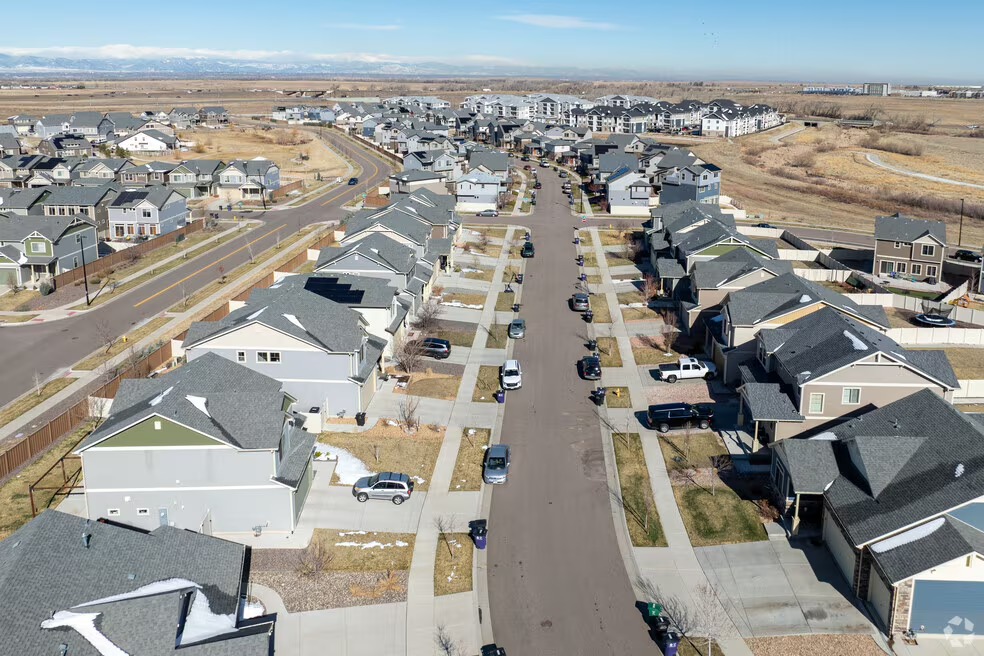
The residential garage door is frequently the largest moving object in a home, yet it is often the most overlooked component of a property’s structural envelope. In the diverse architectural landscape of the modern suburbs, these systems serve as more than just a place to park a vehicle; they are critical barriers against environmental stressors, essential components of a home’s thermal regulation, and a primary security feature. For homeowners across various municipalities, the challenge lies in maintaining a complex mechanical system that must withstand high-cycle usage while enduring the fluctuating humidity and temperature extremes of the regional climate.
When a garage door system begins to fail, the impact radiates through the entire household. A stuck door can trap vehicles inside during a morning commute, while a door that refuses to close properly leaves the home’s interior vulnerable to pests and intruders. Understanding the logistics of overhead door maintenance requires more than just a passing knowledge of springs and cables; it requires an appreciation for the physics of tension and the specific environmental factors that lead to component fatigue.
The Environmental Toll on High-Tension Hardware
In regions characterized by heavy seasonal shifts, the metal components of a garage door are in a constant state of flux. Torsion springs, the massive coils of steel responsible for lifting the door’s dead weight, are particularly susceptible to “hydrogen embrittlement” and thermal cycling. During the winter, the steel becomes more brittle; in the summer, high humidity can lead to surface oxidation that creates microscopic pits in the metal. Each time the door cycles, these pits act as stress concentrators, eventually leading to a catastrophic snap.
Beyond the springs, the “tracks” that guide the door must remain perfectly plumb. However, as homes settle or as the soil beneath the garage slab shifts due to moisture levels, the wooden framing can move. If the tracks fall out of alignment by even a quarter-inch, the rollers will begin to bind. This creates lateral friction that forces the electric opener to pull harder, eventually stripping the internal nylon gears of the motor. For residents looking to verify if professional assistance is available in their specific municipality, reviewing the EK Garage Door Service Areas can help identify local experts who understand these specific geological and climatic challenges.
Acoustic Engineering in Residential Settings
A common misconception among homeowners is that a loud garage door is simply a symptom of age. In reality, noise is a diagnostic signal. A grinding sound often indicates that the bearings in the rollers have failed, while a rhythmic “slapping” sound usually suggests that the lifting cables have become loose or are rubbing against the drums. In high-density residential areas, a noisy door isn’t just a personal nuisance; it is an acoustic intrusion that can disrupt the peace of the entire block.
The transition from standard steel rollers to nylon-coated ball-bearing versions is one of the most effective ways to dampen vibration. Steel rollers act as a conductor, transmitting the vibration of the motor directly into the door panels, which then function like a giant speaker diaphragm. Nylon rollers absorb these micro-impacts, resulting in a whisper-quiet operation. Furthermore, the use of vibration-isolation mounts for the opener’s motor head can prevent the “hum” of the machine from traveling through the joists and into the living spaces above the garage.
Thermal Bridging and Energy Efficiency
For homes with attached garages, the garage door is essentially a massive “thermal bridge.” If the door is uninsulated, it acts as a giant radiator, transferring heat out of the home in the winter and into the home during the summer. This is particularly problematic for households with a “bonus room” located directly above the garage. Without a properly insulated and sealed door, the floor of that room will remain uncomfortably cold regardless of how high the thermostat is set.
Modern door construction has solved this through the use of polyurethane foam injection. Unlike older polystyrene “sheets” that were tucked into the back of the door, injected polyurethane expands to fill every crevice of the door’s interior. This creates a structural “sandwich” that is not only highly energy-efficient but also incredibly rigid. This rigidity makes the door more resistant to wind-loading and accidental impacts. However, an insulated door is significantly heavier than a non-insulated one, which means the spring system must be precisely calibrated to handle the additional mass. Ensuring that the spring tension matches the door’s R-value is a critical step in any professional installation.
The Logic of Modern Safety Sensors
Since the early 1990s, safety sensors, often called “photo-eyes”, have been a mandatory feature for all residential openers. These sensors project an invisible infrared beam across the base of the door opening. If the beam is interrupted while the door is closing, the motor immediately reverses. While this is a life-saving feature for households with children and pets, it is also a frequent source of technical frustration.
In certain times of the year, the “angle of incidence” from the sun can actually blind the receiver sensor, tricking the system into thinking an object is in the way. Additionally, the vibration of the door itself can cause the sensor brackets to vibrate loose over time. A professional technician doesn’t just realign the eyes; they check the “logic board” of the opener to ensure the sensitivity settings are within the manufacturer’s safety tolerances. This prevents “phantom” reversals where the door refuses to stay closed for no apparent reason.
Security and the Modern “Smart” Entry
The garage is often the “soft underbelly” of home security. Older openers used “fixed” radio frequencies that could be easily intercepted by “code grabbers.” Modern entry systems, however, utilize rolling code technology, which changes the access code every time the button is pressed, making it virtually impossible for an outsider to duplicate the signal.
Furthermore, the integration of Wi-Fi technology allows homeowners to monitor their garage door from anywhere in the world. Being able to verify that the door is closed while you are at work, or receiving an alert if the door is opened at an unusual hour, adds a layer of psychological security that traditional locks cannot provide. These smart systems can also be integrated with home automation hubs, allowing the garage lights to turn on automatically when the door is activated, illuminating the path for the driver.
Longevity Through Proactive Stewardship
Ultimately, the lifespan of a garage door system is determined by the consistency of its maintenance. A system that is ignored will likely require a full replacement within ten to twelve years, whereas a well-maintained system can easily last twenty-five. Tightening the lag screws that hold the tracks to the wall, lubricating the hinges with a silicone-based spray, and checking the “balance” of the door are tasks that take very little time but prevent the most expensive types of mechanical failure.
By understanding the physics of the machine and respecting the environmental pressures it faces, homeowners can ensure their garage remains a secure, quiet, and efficient part of their property. Whether you are in a quiet cul-de-sac or a busy urban center, the integrity of your entrance is a cornerstone of your home’s overall health. If you are unsure about the current state of your system, referencing a professional guide to EK Garage Door Service Areas can connect you with the expertise needed to keep your home’s largest moving part in peak condition.

