

Solar energy is everywhere in academic syllabi now. Slides, diagrams, efficiency formulas. Students see all of it. What many of them never see is a solar system that refuses to behave the way the slide says it should.
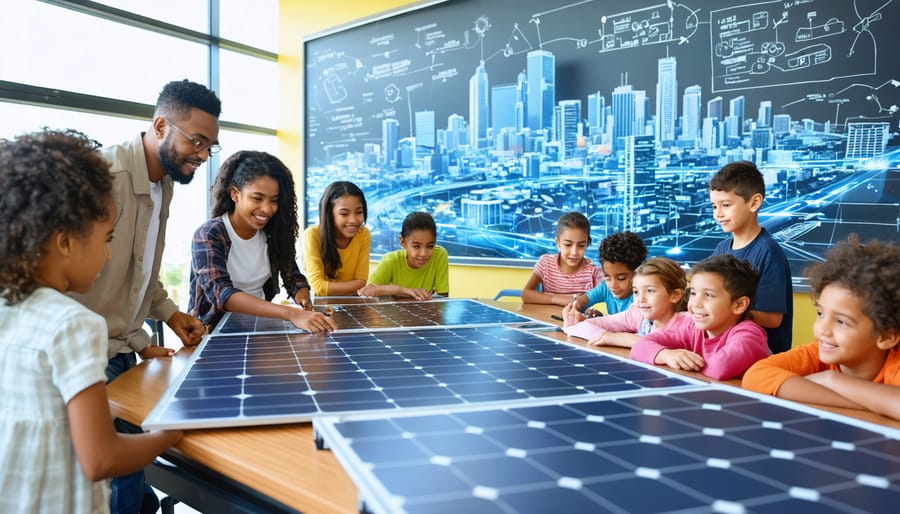
That is where a campus solar lab changes the learning experience. The first time students notice power output dropping for no obvious reason, they stop memorising. They start paying attention. Real systems are messy. They heat up, they fluctuate, and they expose assumptions very quickly. That exposure is valuable.
Why classroom learning reaches a ceiling
There is a limit to what lectures can do. Students can solve numerical problems perfectly and still struggle to explain why a panel underperforms on a warm afternoon.
In a solar lab, that gap becomes obvious. Measurements do not line up neatly. Temperature shifts matter. Wiring quality matters. Even small shadows create effects that theory often glosses over.
Once students experience this mismatch, their understanding deepens. Concepts stop being isolated topics and start forming a system in their minds.
Skills that develop without being taught
Solar labs teach things no syllabus lists explicitly. Students learn patience. They learn how to check the same connection twice. They learn that the first dataset is rarely the best one.
These habits form naturally when experiments depend on physical hardware. A wrong assumption shows up immediately in the readings.
Students who work regularly in a solar lab tend to approach final-year projects differently. They plan better, test more, and trust results only after verification.
Research stops feeling theoretical
Many undergraduate research projects struggle because they never leave paper. Solar labs remove that limitation.
Students can test degradation, compare technologies, or study control behaviour under changing conditions. These are not simulated problems. They are the same questions industry engineers and researchers deal with.
A functioning solar lab allows students to make mistakes early, redesign experiments, and still arrive at meaningful outcomes. That process matters more than polished results.
Collaboration happens by necessity
Solar systems do not belong to a single discipline. When a lab is shared, collaboration becomes unavoidable.
Electrical students focus on power electronics. Others examine thermal behaviour or performance trends. Discussions happen around equipment, not whiteboards.
This environment reflects real projects far better than isolated coursework. Students learn how different viewpoints affect decisions, often without realising it.
Confidence grows through failure
Solar labs break things. Sometimes readings fail. Sometimes setups do not work at all.
That is not a drawback. That is the point. When students troubleshoot inside a solar lab, they learn how to stay calm and methodical. They stop seeing failure as a dead end and start treating it as feedback. That confidence stays with them long after graduation.
Closer alignment with industry reality
Employers in renewable energy look for graduates who understand systems, not just theory. Campus solar labs expose students to equipment, safety practices, and operational limits early.
Students learn how long tests take, how documentation works, and why shortcuts cause problems later. Graduates with solar lab experience usually adapt faster in professional environments. They have already dealt with unpredictability.
Better outcomes for advanced research
For postgraduate students, consistency matters. A solar lab provides controlled access without stripping away realism. Models can be validated repeatedly. Control strategies can be refined. Data can be trusted because conditions are understood. This reliability improves both research depth and output quality.
A different view of sustainability
Seeing energy generation up close changes how students talk about sustainability. It becomes practical, not rhetorical. Students begin asking harder questions about efficiency, limits, and trade-offs. That perspective shapes future research and career decisions. A campus solar lab quietly influences how students think about energy responsibility.
The long-term effect on campuses
Over time, solar labs become more than teaching spaces. They support research funding, industry collaboration, and stronger academic programs.
For students, the impact is clear. Learning feels real. Research feels possible. A well-used solar lab does not just support education. It changes how students think, test, and question renewable energy systems.

