

For generations, learning anatomy meant moving between textbooks, lectures, plastic models, and carefully scheduled laboratory sessions. Each resource offered something useful, but none could place a complete, manipulable human body in front of every student at any time. That limitation is fading. WebGL is bringing interactive 3D content into ordinary browsers, while artificial intelligence is making digital learning environments more responsive to individual students.
Together, these technologies are changing medical education from a largely static experience into one that is visual, exploratory, and increasingly adaptive. They do not replace clinical practice, expert teaching, or validated medical content. Their value lies in making those foundations easier to access, examine, and apply.
Why WebGL matters for medical learning
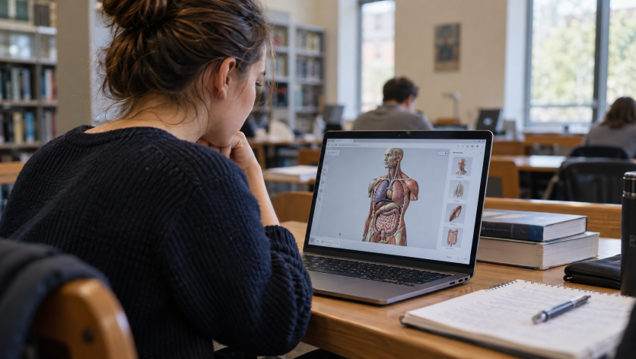
WebGL is a browser technology that uses a device’s graphics hardware to render interactive two- and three-dimensional content. For medical education, its most important feature is not visual spectacle but distribution. A student can open a compatible browser and work with a 3D scene without installing a large specialist program on every computer.
This approach reduces friction for universities, training providers, and learners. The same model can be embedded in a learning management system, opened during a lecture, or reviewed later from a personal device. Students can rotate an organ, isolate a structure, change the viewing angle, and examine spatial relationships that are difficult to infer from a flat illustration.
Browser delivery also makes 3D content easier to place inside a wider lesson. A model can sit beside explanatory text, a clinical case, an assessment, or a discussion prompt. Instead of treating visualization as a separate activity, educators can make it part of the normal learning sequence.
AI adds an adaptive layer
WebGL changes how medical content is presented. AI can change how students interact with that content. Used carefully, AI systems can help generate formative questions, adjust the difficulty of an exercise, provide immediate feedback, and guide learners toward topics that need more attention.
Consider an anatomy lesson in which a student explores the branches of a cranial nerve. A conventional digital model shows the structures. An AI-supported lesson could ask the student to identify a branch, explain its function, and predict the symptoms associated with an injury. If the answer reveals a misconception, the system could offer a simpler prompt or return the learner to the relevant structure.
AI can also support case-based learning. A virtual patient may present a changing set of symptoms, while the learner asks questions, selects examinations, and develops a differential diagnosis. The system can vary the scenario and provide feedback, giving students additional opportunities to practise reasoning before they encounter similar situations in clinical settings.
When WebGL and AI work together
The most interesting change occurs when interactive visualization and adaptive guidance share the same learning environment. The 3D model provides spatial context; AI provides questions, explanations, and feedback. A possible learning sequence might look like this:
- A student explores an interactive model and selects a structure.
- The system presents a question connected to that structure and the learner’s level.
- The response determines whether the next task reinforces a prerequisite or introduces a more complex clinical scenario.
- The instructor receives a summary of recurring errors across the class and can address them in the next session.
Institutions do not necessarily need to build the entire 3D delivery layer from scratch. For example, VOKA provides an embeddable 3D anatomy viewer that can place interactive anatomy and pathology models inside websites, applications, and learning platforms. A browser-based viewer can supply the visual foundation, while an institution connects it to its own curriculum, assessments, or AI-supported tutoring workflow.
This modular approach matters because universities have different teaching goals and technical resources. Some may want a focused model inside one course. Others may build a broader platform that combines anatomy, pathology, clinical cases, and performance analytics.
What medical schools must get right
The technology is promising, but medical education has a much lower tolerance for error than a typical consumer application. A visually impressive experience is not automatically a reliable learning tool. Institutions should evaluate several areas before adoption.
Medical accuracy and human review
Anatomical models, labels, explanations, and generated feedback must be checked by qualified specialists. AI can produce confident but incorrect statements, so it should not become an unsupervised source of medical truth. Educators need a clear process for reviewing content and correcting errors.
Privacy and data governance
Personalized systems may collect answers, progress data, and behavioral information. Schools should know what is stored, where it is processed, who can access it, and how long it is retained. Real patient information should never be placed into an educational AI tool without appropriate safeguards and authorization.
Accessibility and performance
Detailed 3D models can demand substantial graphics and network resources. Developers need to optimize assets, loading behavior, and controls for a range of devices. Educational alternatives should also be available for learners who use assistive technologies or cannot run the full interactive experience.
Transparent assessment
AI-generated feedback is useful for practice, but high-stakes assessment requires stronger oversight. Students should understand how their work is evaluated, and educators should be able to inspect the reasoning behind automated recommendations.
The educator remains central
As digital tools become more capable, the role of the teacher does not disappear. It becomes more focused on judgment. Educators select trustworthy resources, design meaningful cases, identify when a learner is applying a rule without understanding it, and connect digital practice to real clinical responsibilities.
AI may help identify patterns in student performance, but a lecturer must decide what those patterns mean. A 3D model can reveal spatial relationships, but an experienced clinician explains why those relationships matter during diagnosis or treatment. The strongest learning environments will use technology to extend expert teaching rather than imitate or replace it.
A practical path to adoption
Medical schools do not need to transform an entire curriculum at once. A focused pilot is often more useful than a large technology rollout. A sensible process is to:
- Choose one topic where spatial understanding or repeated practice is a known difficulty.
- Define the learning outcome before selecting the technology.
- Test the experience with students and instructors using different devices.
- Measure comprehension, usability, and the quality of feedback—not engagement alone.
- Expand only after the content, governance process, and technical support have been validated.
This approach keeps educational needs ahead of novelty. It also gives institutions evidence for deciding where browser-based 3D and AI genuinely improve learning and where a simpler method remains more effective.
From a browser window to a learning environment
The browser is becoming more than a place to read course material. With WebGL, it can become an interactive anatomy laboratory. With AI, it can respond to the learner, vary a case, and provide timely practice. The real transformation, however, will not come from either technology alone. It will come from combining accessible visualization, carefully designed instruction, expert validation, and responsible use of student data.
Medical education has always depended on seeing, questioning, practising, and receiving feedback. WebGL and AI do not change those principles. They make it possible to deliver them in new ways—and to more learners than a physical laboratory or fixed classroom schedule could reach on its own.

