

Key Takeaways
- AI automates time-consuming recruitment tasks, such as resume screening and interview scheduling.
- The technology can help minimize unconscious bias and foster greater inclusion and diversity in the workplace.
- With the help of AI, companies deliver highly personalized candidate experiences and streamline communication.
- While AI presents significant benefits, it also introduces new considerations regarding privacy, fairness, and transparency.
Artificial Intelligence has swiftly moved from a futuristic concept to an essential part of modern business practices. In the field of hiring and talent acquisition, AI in recruiting is now at the forefront of transforming tedious, manual processes into streamlined, intelligent workflows. Organizations today are leveraging advanced algorithms and predictive analytics to make smarter, more impartial hiring decisions while accelerating the entire recruitment cycle.
Intelligent recruiting tools help companies overcome traditional barriers to finding the right talent. By combining automation and data-driven insights, AI not only matches candidates with suitable job openings but also enhances candidate interactions and improves hiring team productivity. With businesses facing increased competition for top-tier talent, AI has become crucial for staying agile and meeting hiring goals efficiently.
As organizations increasingly adopt AI-based tools, it is important to recognize not only the efficiencies but also the ethical implications. Recruiters and HR leaders must be vigilant in ensuring their AI systems are built and used responsibly, and prepared for an ongoing process of learning and adaptation in this rapidly changing landscape. For more on how leading companies are approaching ethical integrations of technology in hiring, visit SHRM’s overview on AI in HR.
Automating Resume Screening and Candidate Matching
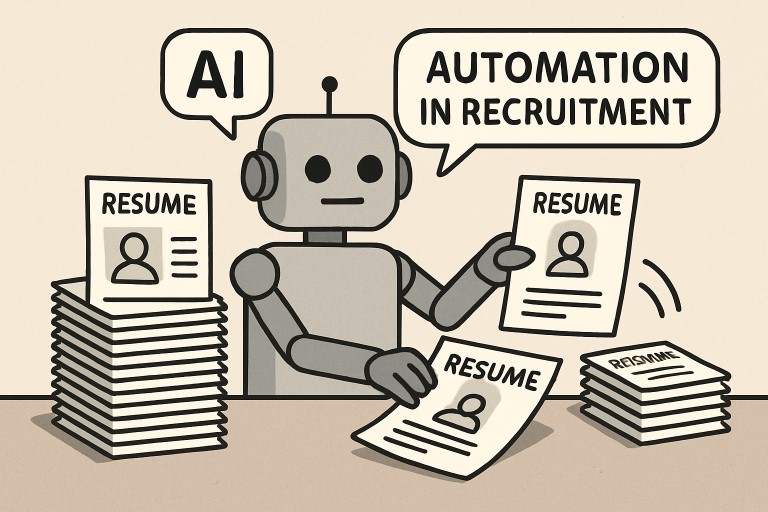
One of AI’s most valuable functions is its ability to sort through thousands of resumes in seconds. The software rapidly identifies skills, education, and experience that align with job criteria, enabling recruiters to create a shortlist of top talent. For example, Unilever’s use of AI screening and video interview analysis reduced its hiring process from 4 months to 4 weeks, saving thousands of hours and delivering more consistent candidate evaluations. This automation frees up recruiters to focus on building relationships, conducting in-depth interviews, and making final hiring decisions based on nuanced, human judgment.
Reducing Unconscious Bias
Unconscious bias has long been a barrier to equitable hiring. AI can help mitigate this issue when systems are properly designed by relying on objective data rather than subjective perceptions. Machine learning models evaluate candidates based on skills, experience, and other relevant factors, rather than personal characteristics, potentially leading to a more equitable process. However, it is vital that the data used to train these algorithms is representative and diverse; otherwise, the AI may reinforce existing biases. According to experts, AI tools are making strides in reducing bias, but human oversight and ongoing evaluation are necessary to keep systems fair.
Enhancing Candidate Engagement
AI is also transforming the candidate journey by making communication more timely and relevant. Tools such as chatbots can answer common questions, guide applicants through the application process, and automatically provide updates. This level of personalized interaction leads to higher candidate satisfaction and a stronger employer brand. AI-enabled communication keeps candidates informed, reduces anxiety, and helps prevent applicants from dropping out of the process. Companies that invest in candidate-centric AI solutions report higher acceptance rates and more positive applicant feedback.
Challenges and Considerations
Despite its transformational benefits, deploying AI in recruitment is not without challenges. Concerns about privacy, data security, and algorithmic accountability are top of mind for HR teams. Organizations must ensure transparency, comply with existing regulations, and regularly audit recruitment algorithms to prevent inadvertent discrimination or breaches of confidentiality. Only 37 percent of U.S. hiring leaders currently feel well-prepared to navigate these challenges, underscoring a critical need for more training and adherence to industry best practices as AI adoption accelerates.
Balancing AI and Human Interaction
While AI excels at data analysis and repetitive tasks, human qualities such as empathy, intuition, and ethical judgment remain irreplaceable. The most effective recruitment strategies combine the speed and scalability of AI with the insight of experienced recruiters. Human involvement is crucial for interviewing, assessing cultural fit, and making the final hiring decision. Leading experts agree that while AI is redefining recruitment roles, it does not diminish the value of skilled HR professionals, who are essential for interpreting AI-driven insights and nurturing candidate relationships.
Future Outlook
The future of recruitment will be defined by more advanced uses of machine learning, natural language processing, and predictive analytics. AI will become more adaptive and able to evaluate soft skills and cultural alignment with greater nuance. Organizations that invest in transparent, ethically managed AI solutions will be positioned to compete more effectively for top talent while ensuring fair and inclusive hiring practices.
In summary, AI is changing recruitment by making hiring faster, more equitable, and more candidate-focused. Responsible implementation, combined with strategic human oversight, will remain key to harnessing the full potential of AI in recruitment for years to come.

