

A hungry baby does not wait, and a cold bottle will not do. Anyone who has fed a baby away from home knows the sequence: the hunger cries start, you reach for a bottle from the bag, and then begins the improvisation. Holding it under a restaurant sink’s tepid trickle. Asking a coffee shop for a cup of hot water and rotating the bottle in it like a ritual. Settling for room temperature while your baby protests that this is not what was expected. At home, warming a bottle is a solved problem with a countertop device and a kitchen outlet. The moment you leave the house, the solution evaporates, and every parent ends up improvising in parking lots, on flights, in the back rows of family gatherings. A portable bottle warmer exists to close that gap. It takes the certainty of a home warming routine and packs it into something that lives in a diaper bag, so a perfectly warmed bottle is available wherever the day happens to go. This article looks at why bottle temperature matters more than convenience alone, the technologies that make on-the-go warming actually work, and how to choose and use a travel warmer that will not let you down at the moment your baby needs it most.
Why Bottle Temperature Is About More Than Picky Babies
There is real science behind a baby’s preference for warm milk. Breast milk is naturally at body temperature, and formula is designed to be mixed and served warm, so a warm bottle is simply what a bottle is supposed to feel like to a baby. Cold milk can be a genuine feeding obstacle: the temperature difference startles some infants, slows the feeding, and causes babies to take less milk before giving up, which matters enormously during night feeds when you want a full feed to mean a longer sleep. Temperature also interacts with fat distribution. Milk fat separates and clings to the bottle walls when chilled, and gentle warming re-emulsifies the fat so the baby receives the full caloric content rather than the watery portion.
Safety defines the other boundary. Overheating is not just a comfort issue: excessive heat degrades nutrients in breast milk and can scald a baby’s mouth, since infants cannot flinch away from a liquid they are mid-swallow on. This is why the gold standard for warming is gradual and controlled, raising milk to approximately body temperature, warm to the inner wrist but never hot, without ever overshooting. A parent swirling a bottle in a cup of unknown-temperature coffee water has no way to meet this standard. A purpose-built warmer does.
How Portable Warmers Solve Problems No Thermos Can
Travel warming technology comes in a few distinct approaches, each solving a different part of the problem. Battery-powered warmers heat directly and independently, drawing on an internal rechargeable battery to warm a bottle anywhere, including places with no outlet in sight. Car-plug warmers use the vehicle’s power for road trips and school-run schedules, turning drive time into warming time. Thermal flask systems take a different route entirely: boiling water is stored in an insulated flask and released into a warming sleeve around the bottle when needed, which warms without any electricity at the moment of feeding and is immune to dead batteries and dead zones.
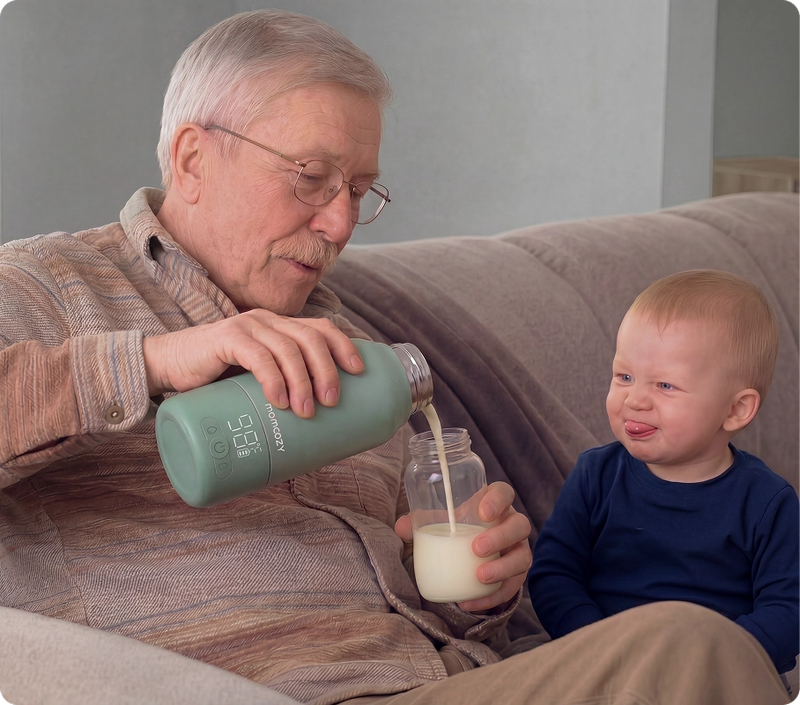
What separates a useful portable warmer from a frustrating one is precision and speed. A device that warms gradually to a controlled target temperature protects nutrients and consistency, while a device that simply dumps heat at a bottle overshoots and underfeeds alternately. Smart designs add a timed cycle and a temperature indicator, so the parent knows the milk is at feeding warmth without the wrist test, and a warming cycle fast enough to finish before the hunger crying escalates into the inconsolable phase. The travel-specific details matter too: the unit has to fit the bottle shapes you actually use, survive being dropped in a bag, and clean easily, since warmers accumulate milk residue at exactly the temperature bacteria enjoy.
Matching Warmer Type to Your Real Life
The right choice depends on where your away-from-home feeds actually happen. Urban parents walking and taking transit usually favor battery-powered units for their total independence. Parents whose days are structured around drives lean toward car-powered warmers and start the warming cycle as the drive home begins. The thermal-flask approach wins for flights, hikes, and long days away from any charging opportunity, and for parents of multiples, since it warms several bottles from a single flask of hot water. Many families end up using a battery warmer as the daily driver and keeping the flask system for travel days, which is a reasonable division of labor rather than redundancy.
Building a Feeding Routine That Travels With You
A travel warmer earns its place through habits as much as hardware. Pre-chill bottles for outings and warm only what will be consumed in the moment, since repeated warming and cooling cycles invite bacterial growth and degrade the milk. Set up a feeding kit in the diaper bag as a standing unit: warmer, one or two bottles of prepared milk, a burp cloth, and the charging cable for the battery unit, replenished after each outing rather than assembled fresh each time. The parents who find the warmer transformative are the ones who stop thinking about warming entirely because the kit is always packed and always ready.
Care habits extend the life of the device and the safety of the milk. Rinse the warming chamber or sleeve after any spill, and wash the milk-contact parts daily during periods of heavy use. Run a periodic descaling cycle if the unit heats water directly, since mineral buildup on the heating element first slows warming and eventually compromises it, exactly the failure mode you do not want to discover at a roadside feeding. Charge the battery after every significant use rather than when you remember, treating the charger like the bottle brush, part of the daily reset rather than an occasional chore.
The payoff arrives in the moments that define travel with a baby. A flight delayed on the tarmac becomes manageable when a warm bottle appears on schedule. A long hike, a wedding, a visit to grandparents three hours away, all become ordinary outings instead of logistics puzzles with a hungry baby as the timer. Momcozy’s portable warming line is built around this exact promise of home-routine certainty on the road, with battery-powered and car-powered models sharing the controlled-temperature heating approach, which is why the collection is a fixture in travel-preparation discussions among parents.
Choosing Before You Need It, Not After
The best time to acquire a travel warmer is before the first trip that exposes the gap, because discovering the improvisation problem mid-crying-baby is a memorable way to learn. Compare the power source against your typical days, the warming time against your baby’s patience, and the physical dimensions against both your diaper bag and your bottles. Check that the warming chamber accommodates the bottles you already own rather than committing to new bottles alongside the warmer. For parents weighing the options, browsing a focused portable bottle warmer collection lays out the power-source and capacity trade-offs clearly, and the comparison is genuinely worth doing before the baby makes the decision urgent.
The Bottle That Travels Like It Never Left Home
Leaving the house with a baby should not mean leaving behind the parts of your feeding routine that work. A portable bottle warmer takes the one element of feeding that improvisation handles worst, bringing milk safely and precisely to feeding temperature, and makes it location-independent. Whether powered by battery, car socket, or an insulated flask, a good warmer delivers controlled warmth without overheating, fast enough to beat the escalation of hunger, and portable enough to live permanently in the bag. Chosen to match where your days actually go and maintained with the same discipline as the bottles it warms, it removes a whole category of stress from parenting away from home. The world with a baby is big and worth visiting. With warm milk on demand, it is also far easier to enjoy.

