

Two quotes for the same Odoo project can differ by three times, and both vendors can be quoting honestly. Hard to believe, but it’s the key to reading any Odoo development company proposal correctly. The quotes differ because they’re pricing different assumptions about four separate cost layers, and until you can see the layers you can’t compare anything at all.
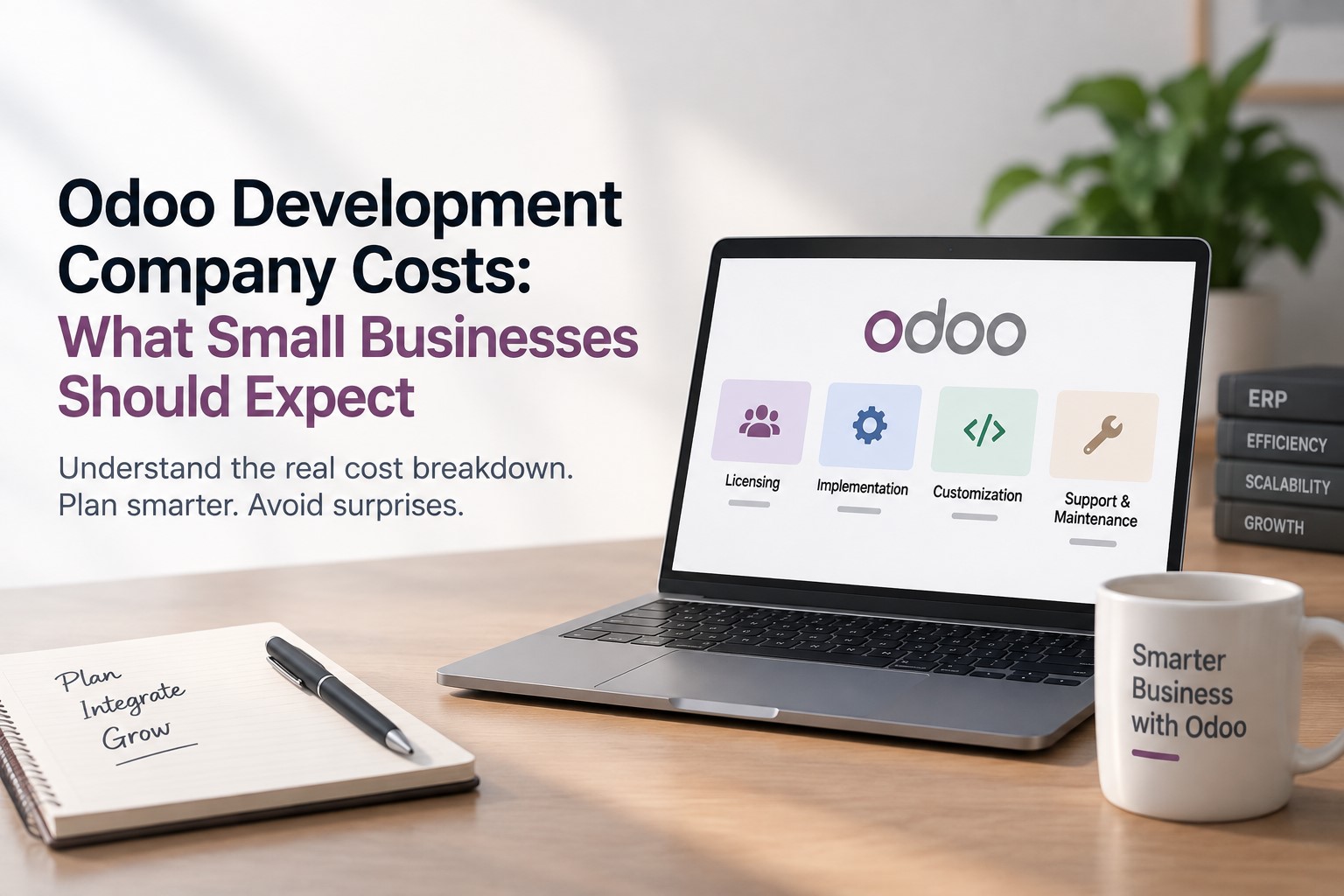
Here’s the anatomy, with realistic ranges and the spots where budgets actually go wrong.
The Four Layers Every Quote Contains
Licensing comes first and it’s the most predictable. Odoo Enterprise is priced per user per month. You can verify that one number yourself on Odoo’s pricing page in five minutes. Community edition is free, though the free-license route usually shifts cost into the next layer rather than removing it, because features Enterprise ships natively get rebuilt as custom work.
Implementation is the setup of standard Odoo around your business: chart of accounts, workflows, user roles, data import, training. For a small business on a near-standard setup, industry pricing guides put the realistic annual all-in figure (licensing and support included) somewhere between $12,000 and $35,000. A fuller SME deployment with more users and modules tends to land in a $15,000 to $60,000 band instead. Where you sit in the range depends mostly on user count and how much of your process matches standard Odoo.
Customization is where quotes truly diverge. A simple custom automation might run around $2,000. A complex integration or specialized workflow module can reach $15,000 or more, and custom work commonly ends up around 20 to 30% of a total implementation budget. This is also the layer with a hidden second price: every custom module has to be carried across future Odoo versions. A $10,000 module is really $10,000 plus an upgrade cost that repeats. Ask for both numbers in writing.
Support and maintenance is the layer small businesses forget to budget entirely. A common rule of thumb is 15 to 20% of implementation cost per year. Typical arrangements for smaller deployments sit at the low end of the wider $5,000 to $50,000 annual band. Near-standard instances are cheap to keep running. Heavily customized ones aren’t, which is the same story as the customization layer wearing a different hat.
Why the Cheap Quote Is Usually the Expensive One
A low quote generally means one of three things, and only one of them is good news. Sometimes the vendor scoped honestly against a genuinely simple requirement, which is great. More often, the quote simply excludes a layer. Implementation without training is the classic version. Customization priced “as needed” later runs it close, and support sold separately once you’re committed rounds out the set. And occasionally the rate is real but the hours are fantasy, and the gap arrives as change orders in month two.
The fix isn’t complicated. Ask every Odoo development company to break its quote into the four layers explicitly, with what’s excluded named. A vendor who resists that breakdown is telling you where the surprise will come from.
Where Small Businesses Actually Overspend
Rarely the license. Usually not the hourly rate either. The overspend hides two habits.
Customizing what configuration already covers. Standard Odoo and its no-code Studio tools handle a large share of typical requests. Small businesses overspend when an old spreadsheet-era process gets preserved in custom code instead of adapting the process to what odoo erp software development ships out of the box. The cheapest module is the one you didn’t commission.
Deferring the upgrade conversation. Odoo ships a major version yearly, and staying more than three versions behind now carries a 25% surcharge on the subscription. A budget that ignores upgrade cadence isn’t smaller. It’s just quieter for a while, and the deferred cost compounds against you.
A Sanity Check Before You Sign
Take any proposal and answer four questions from it. What’s the per-user license cost, verified against Odoo’s own pricing? What exactly does implementation include, and is training named? Which customizations are in scope, each with a build price and a carry price? And what does year two cost, all in, when the project fee is gone and support plus licensing is what remains?
If the proposal can’t answer all four, the number at the bottom isn’t a budget yet. It’s an opening position.
Firms like BiztechCS, an Odoo Ready Partner with 25+ certified Odoo experts, quote in exactly those layers because the alternative is the month-two change-order conversation nobody enjoys. Small-business Odoo projects go wrong through opacity far more often than through rates.
If you’re collecting quotes right now, send each vendor the four-layer breakdown and ask them to fill it in. Ten minutes of their time, and the comparison becomes real. At BiztechCS, we’d rather compete on a filled-in table than a bottom-line number.

