

Every winter, millions of buildings burn gas or run heat pumps for one reason: to produce warmth. At the same time, Bitcoin miners around the world consume electricity and dump almost all of it into the air as waste heat. Put those two facts side by side and an obvious question appears: why are we paying for heat twice?
A new generation of water-cooled mining hardware is starting to answer that question. Instead of treating heat as a problem to get rid of, hydro-cooled miners treat it as a product. The result is a machine that does two jobs with the same kilowatt-hour: it secures the Bitcoin network and it heats a building.
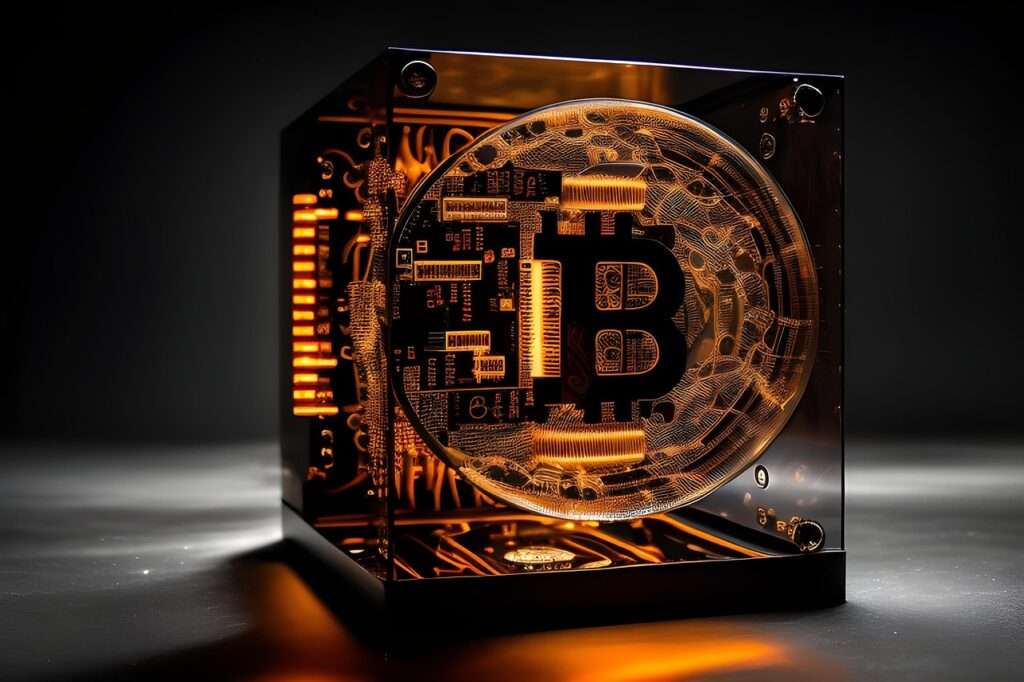
A heater that happens to compute
The physics is simple. Practically all the electricity a mining chip consumes ends up as heat. A miner drawing 5 kW is, thermally speaking, a 5 kW electric heater. The difference is that a normal heater turns electricity into warmth and nothing else, while a miner also produces something with economic value along the way.
That changes the economics of both sides. For a miner, heat that can be sold or used offsets the electricity bill. For a heat consumer, a miner is a heat source that partly pays for itself. Engineers have a name for this kind of arrangement: sector coupling, where the digital and the thermal worlds share the same energy input.
Why air cooling wastes the opportunity
Most miners today are air-cooled. A workhorse like the Bitmain Antminer S21 delivers up to 200 TH/s at roughly 17.5 J/TH and pushes its heat out through powerful fans at around 76 dBA. It is an excellent, affordable machine for getting started, and in a workshop or warehouse its exhaust air can already be ducted to warm a space.
But hot air is a clumsy carrier of energy. It is hard to transport, hard to store and hard to plug into existing heating systems. Most of it ends up vented outside. That is where water comes in.
Hydro cooling: heat you can pipe
Water holds roughly four times more heat per kilogram than air and can be moved through pipes over long distances with little loss. A Bitmain Antminer Hydro unit replaces the fans with a liquid loop that runs directly past the hash boards. Heat leaves the machine as warm water rather than hot air.
The current generation is also remarkably efficient. The Antminer S23 Hydro delivers 563 TH/s at around 9.5 J/TH, and the S23 XP Hyd reaches 600 TH/s at about 8.9 J/TH. Compared to older air-cooled fleets, that is almost half the energy per terahash. And because there are no high-speed fans, hydro miners run far quieter and at more stable temperatures, which also helps their lifespan.
The practical consequence: a hydro miner can be connected to a heat exchanger and plugged into the same kind of loop that would otherwise be fed by a boiler.
Where the heat can go
Once heat travels as water, the list of uses grows quickly:
- Greenhouses. Horticulture needs steady low-temperature heat for months a year. In countries like the Netherlands, where greenhouses are a major industry, a miner can take over part of the job of a gas-fired system.
- District heating. Several European pilots already feed mining heat into local heat networks that serve homes and offices.
- Swimming pools and leisure centres. Pools need constant heat all year round, which matches a miner that runs 24/7.
- Industrial pre-heating. Drying processes, washing systems and food production often need warm water that a miner can pre-heat before a conventional system tops it up.
- Office buildings and underfloor heating. Low-temperature heating systems are a natural match for the warm water a hydro loop can supply, depending on the setup.
The double dividend, in numbers
Take a single S23 Hydro drawing about 5.3 kW. Running continuously, it produces roughly 128 kWh of heat per day, or close to 47,000 kWh per year. For comparison, an average Dutch household uses somewhere around 10,000 to 12,000 kWh worth of gas for heating each year. In theory, one machine produces enough heat for roughly four homes, while mining Bitcoin at the same time.
Of course, real-world numbers depend on seasonal demand, how well the heat is captured and what happens to surplus heat in summer. But the principle stands: the same kilowatt-hour now earns twice.
A flexible load for a stressed grid
There is a third benefit that is easy to overlook. Miners can be switched on and off within seconds without harming the process. That makes them one of the most flexible loads on the grid. When there is a surplus of solar or wind power and prices drop, miners can ramp up and store the energy as heat in a buffer tank. When the grid is under pressure, they can switch off. Heat buffers bridge the gap, so the building stays warm either way.
For grid operators struggling with congestion and negative prices, that kind of controllable demand is valuable. For the owner, it means mining when electricity is cheapest.
What it takes to get started
Hydro mining is more infrastructure-heavy than plugging an air-cooled unit into a wall socket. A typical setup includes:
- a coolant distribution unit (CDU) to manage the liquid loop;
- a heat exchanger or dry cooler to transfer or dump heat;
- server racks to house the miners;
- three-phase power distribution in the 380 to 415 V range.
Many operators start with a few air-cooled machines like the S21 to learn the ropes, then move to hydro once they have a concrete heat demand to serve. Choosing a supplier with local stock, a solid warranty and repair capacity nearby helps keep downtime low, which matters even more when a building depends on the heat.
From waste heat to heat-as-a-service
The most interesting part of this shift is not the hardware but the business model. Instead of selling heat or hashrate separately, companies are starting to offer both as one package: a miner installed on site that heats a greenhouse, office or pool, with the mining revenue lowering the heating bill. In that model, the miner stops being an energy consumer and becomes part of the building’s energy system.
Bitcoin mining has long been criticised for its energy use. Hydro cooling does not make that energy disappear, but it does make sure it gets used twice. In a world that is trying to electrify heating and balance a grid full of renewables, that might turn out to be one of the more quietly innovative ideas in tech.
This article is for informational purposes only and does not constitute financial advice.

